The Convoy Blacklist Needs a Public Damage Ledger
If Ottawa can push protest-related personal data through the financial system during an emergency, Canadians deserve a complete disclosure map afterward.
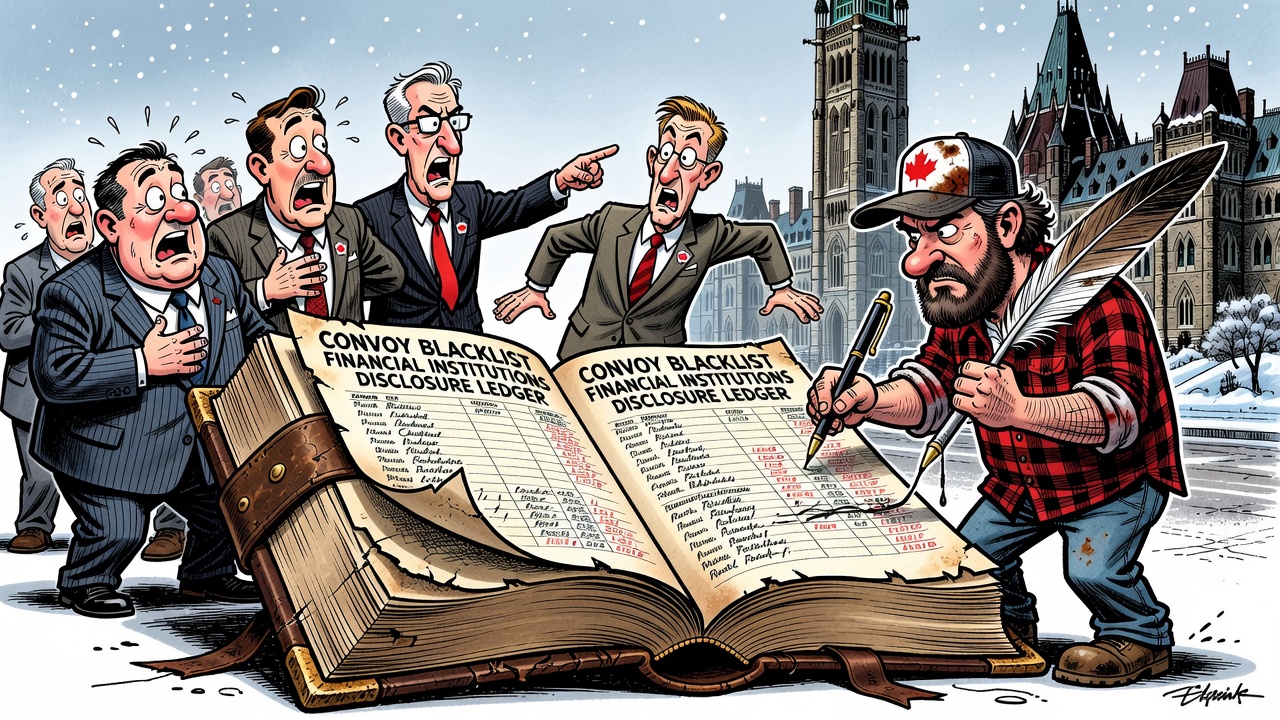
The point is not whether every Freedom Convoy tactic was wise, legal or popular. The point is whether a federal government should be able to attach political-protest suspicion to Canadians’ financial lives, circulate personal information through public and private channels, and then leave the country without a public damage ledger.
A new Counter Signal/Juno report, citing records obtained by Blacklock’s Reporter, says convoy-related blacklist information travelled much farther than the narrow public language Canadians heard in 2022. The report says Ontario regulators circulated the list to roughly 1,000 to 2,000 brokerages and firms, while the list was also shared with up to 50 financial institutions and industry or regulatory bodies. Older Inquiry of Ministry reporting said RCMP disclosures also reached Canadian contacts for foreign institutions, including Bank of China, State Bank of India, BNP Paribas, Citibank, ICICI, Mizuho and Wells Fargo.
Official records already confirm the government created extraordinary financial-information powers. The Privacy Commissioner’s special pandemic report says the Emergencies Act financial measures temporarily authorized public institutions, including the RCMP, FINTRAC and CSIS, to disclose relevant information to financial entities when satisfied it would contribute to applying the emergency order. The RCMP’s Project NATTERJACK review says Federal Policing Criminal Operations Financial Crimes made 57 disclosures to financial institutions involving 62 individuals and 17 businesses under the Emergency Economic Measures Order.
That is not a small administrative footnote. It is a precedent. Once the state can ask the financial system to act against named people in a political emergency, the public must be able to audit every link in the chain: who compiled the names, what fields were shared, who received them, what standard of proof was used, which accounts were frozen, when they were unfrozen, and what happened to the data after the emergency ended.
The government also owes Canadians a safeguards ledger. Were all disclosures encrypted? Who inside banks, brokerages, regulators and associations could access the list? Were recipients ordered to delete or quarantine it? Did Ottawa verify compliance? Were any people listed by mistake? Were any business losses, credit disruptions, account closures or reputational harms later documented? If the answer is “we do not know,” that is exactly why the ledger is needed.
Conservatives should be precise here. The demand is not immunity for illegal blockades, nor a rewrite of police authority. It is the basic rule of free government: emergency power must leave receipts. If the state can move faster than normal due process, then post-emergency disclosure, correction and remedy must be stronger than normal too.
Parliament should require a redacted public disclosure map for the convoy blacklist: originating agency, recipient category, legal authority, data fields, transmission method, retention rule, deletion verification, freeze/unfreeze timeline, appeal path and remedy status. Names can be protected where privacy requires it. The system, however, cannot stay hidden.
- The Counter Signal/Juno: Liberals' blacklist of Convoy sympathizers shared with thousands of corporations
- RCMP: Project NATTERJACK national after-action review
- Office of the Privacy Commissioner of Canada: Protecting privacy in a pandemic
- LifeSiteNews / Blacklock’s Reporter summary: Inquiry of Ministry reporting on foreign-bank contacts
- Federal Court: Canadian Frontline Nurses v. Canada, 2024 FC 42
This article argues for public accounting of emergency financial-data disclosures. It does not claim that every listed person acted lawfully or that all disclosures were unlawful; it asks Ottawa to publish the auditable record, safeguards and remedies.