ArcelorMittal’s Subsidy-and-Fine Ledger Belongs in Public
Ottawa reportedly committed $125M to ArcelorMittal months after a record Fisheries Act fine. Publish the terms, conditions and compliance receipts.
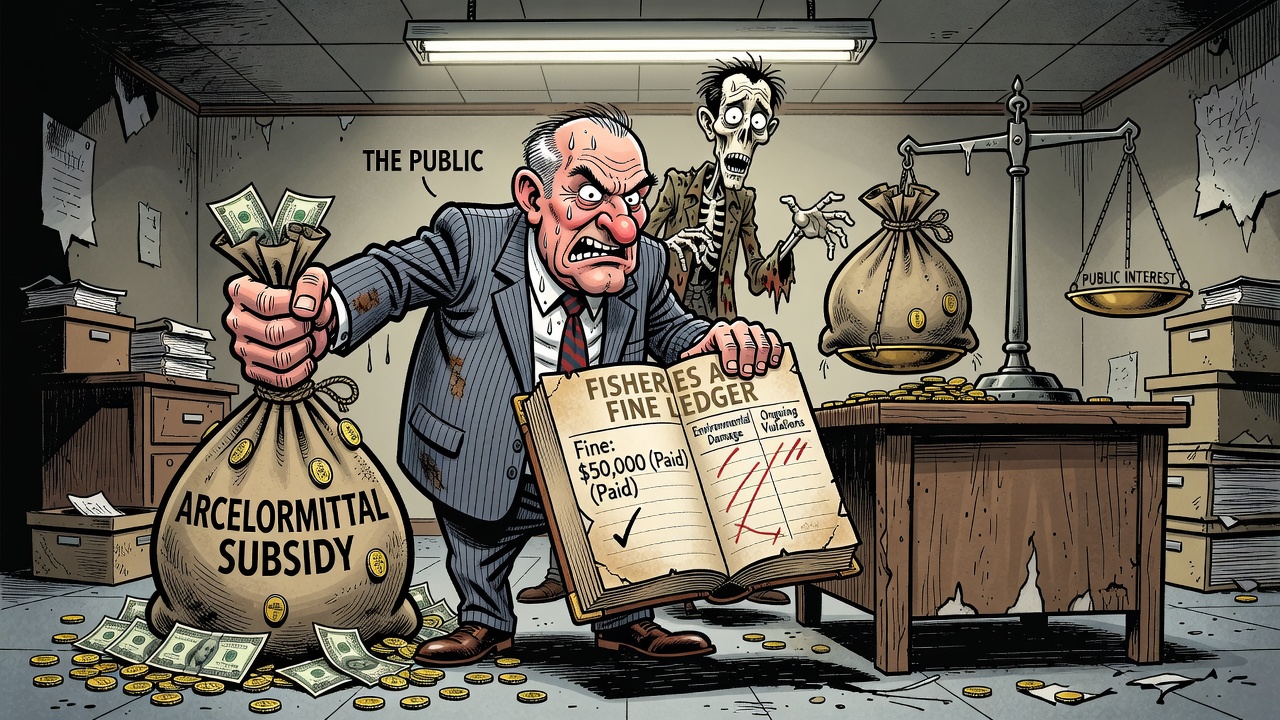
Ottawa’s industrial strategy keeps asking taxpayers to accept two stories at once: that big corporate subsidies are essential to defend Canadian jobs, and that environmental enforcement is tough enough to protect the public interest. The reported ArcelorMittal file is where those two claims collide.
Research Money’s August 12 short report, summarizing The Logic’s reporting, says the Government of Canada committed $125 million to help fund expansion of Luxembourg-headquartered ArcelorMittal’s Quebec pellet plant. The money is reported to flow through the Strategic Response Fund, a federal program for large private-sector projects in priority sectors. The same summary says the Port-Cartier project is tied to direct-reduced iron pellets for lower-emission steel and includes a flotation system expected by the company to reduce silica, use less energy and eventually lower greenhouse-gas emissions by 200,000 tonnes a year.
Those goals may sound worthy. But they do not erase the public ledger. On May 15, Environment and Climate Change Canada announced that ArcelorMittal Exploitation Minière Canada s.e.n.c. had pleaded guilty to 100 Fisheries Act counts and was sentenced by the Court of Québec to pay $100 million — described by Ottawa as the highest fine ever imposed in Canada under that law. The government said the violations involved deposits between May 2014 and May 2022 at the Mont-Wright and Fire Lake operations in the Fermont region, including low-pH effluents, elevated zinc, nickel or suspended solids, and effluents toxic to fish.
The court order also matters. Ottawa said the company must reimburse nearly $250,000 in investigation costs and produce, by mid-February 2027, a detailed action plan covering effluent management for Mont-Wright and Fire Lake, plus mine-drainage measures at Mont-Wright. That means the public compliance file is not just historical. It is still open.
So the accountability question is simple: why should taxpayers learn about the subsidy before they can see the full conditions attached to it?
No one needs to overclaim. A criminal sentence in one operating entity does not automatically make every future industrial investment illegitimate. A pellet-plant expansion could support jobs, cleaner steel inputs and regional economic activity. But when a global steel and mining giant linked to a record federal environmental fine is reportedly receiving a larger federal contribution months later, “trust us” is not a standard. It is a loophole.
Ottawa should publish the contribution agreement, the recipient entity, whether the support is repayable or non-repayable, any beneficial-ownership review, job and wage commitments, emissions-performance milestones, clawback clauses, lobbying contacts, ministerial briefing notes, and every environmental-compliance condition tied to the money. It should also say whether the May 2026 conviction affected due diligence, risk scoring, payment timing, or holdbacks.
The Strategic Response Fund is supposed to strengthen Canadian industry. Fine. Then strengthen confidence too. Taxpayers can handle complicated tradeoffs. What they should not be asked to handle is a subsidy cheque in one hand and an unfinished environmental compliance ledger in the other.
- Research Money: The Short Report — August 12, 2026
- Environment and Climate Change Canada: ArcelorMittal fined $100 million for Fisheries Act violations
- Innovation, Science and Economic Development Canada: Strategic Response Fund call for proposals
- ISED: Strategic Response Fund funding overview
This article argues for disclosure and conditions. It does not claim the reported funding decision is unlawful, that ArcelorMittal’s pellet-plant project caused the Fisheries Act violations, or that the company has failed to comply with the court’s future action-plan deadline.