Carney’s Aid-for-Trade Pivot Needs a Legal Receipts Test
If Ottawa says foreign aid can chase trade spinoffs and still obey Canada’s poverty-reduction law, publish the program-by-program receipts.
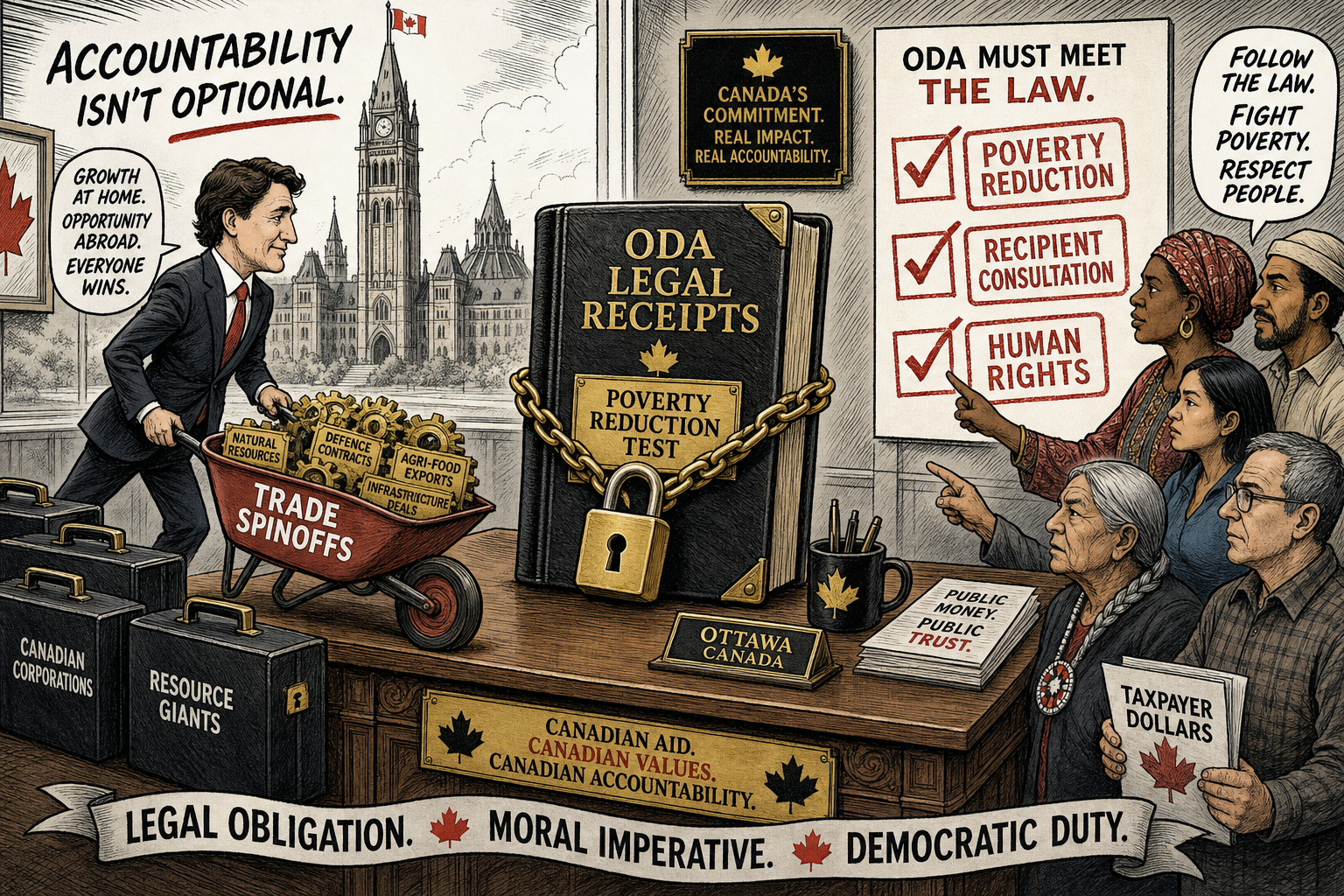
Foreign aid is not a blank cheque for Ottawa’s industrial strategy. If the Carney government wants to link development dollars more tightly to Canadian trade outcomes, it must show Canadians the legal receipts before it sells the pivot as smart diplomacy.
The Canadian Press reported August 12 that aid-sector voices are increasingly concerned about how closely the government is tying foreign aid to domestic economic growth. The same report said Prime Minister Mark Carney has cut foreign aid, moved the international-development role from a ministerial post to a secretary of state, and assigned a parliamentary secretary to oversee both trade and aid. That is not a minor staffing shuffle. It signals that development spending is being pulled into a trade-and-growth frame.
Global Affairs Canada’s answer is that Canada remains “fully committed to, and compliant with” the 2008 development-spending law and is not practising tied aid. The department also told CP that aid can remain untied while supporting “mutually beneficial economic relationships” with partner countries. Fine. Then prove it, program by program.
The law is not vague on the core test. The Official Development Assistance Accountability Act says Canadian official development assistance must have a central focus on poverty reduction. Section 4 says it may be provided only if the competent minister is of the opinion that it contributes to poverty reduction, takes into account the perspectives of the poor, and is consistent with international human rights standards.
That is why former Liberal MP John McKay’s warning matters. McKay, who sponsored the 2008 law, told Canadian Affairs in March that the new direction raises the question of whether Ottawa is breaking the law and called it “a more sophisticated version of tied aid.” Canadian Affairs also reported in June that Carney announced a $2.7 billion cut to development assistance while committing $2.5 billion in economic assistance to Ukraine, and quoted experts warning that any aid counted as ODA must keep poverty reduction as its central purpose.
A conservative accountability standard does not require pretending every trade link is illegal or every aid dollar is wasted. It requires a ledger. For each program Ottawa counts as ODA, publish the poverty-reduction objective, recipient-country consultation record, human-rights screen, procurement rules, Canadian corporate beneficiaries, expected trade spinoffs, and legal sign-off under the 2008 Act.
If the benefit to Canadian exporters is incidental, the ledger will show it. If commercial returns are driving where money goes, which sectors win, and which outcomes count as success, Canadians deserve to know that too.
The Carney government cannot have it both ways: claiming moral credit for poverty reduction while quietly measuring success by Canadian market access. Aid can support stability, partnerships and long-term trade, but the legal centre of gravity remains poverty reduction. Publish the receipts, or stop calling the pivot accountability.
- CityNews / The Canadian Press: Why Canada’s deeper linkage of foreign aid with trade outcomes is raising concerns
- Canadian Affairs: Architect of aid law warns of Canada’s new approach to aid
- Canadian Affairs: Canada’s “shadow aid” policy
- Justice Laws Website: Official Development Assistance Accountability Act
This article argues for transparency and legal compliance receipts. It does not allege that a specific program has been judicially found unlawful.