The Telesat Satellite Deal Needs a Conflict-Screen Ledger
A multibillion-dollar defence-satellite agreement deserves public procurement receipts, contract terms and a clear conflict-screen record.
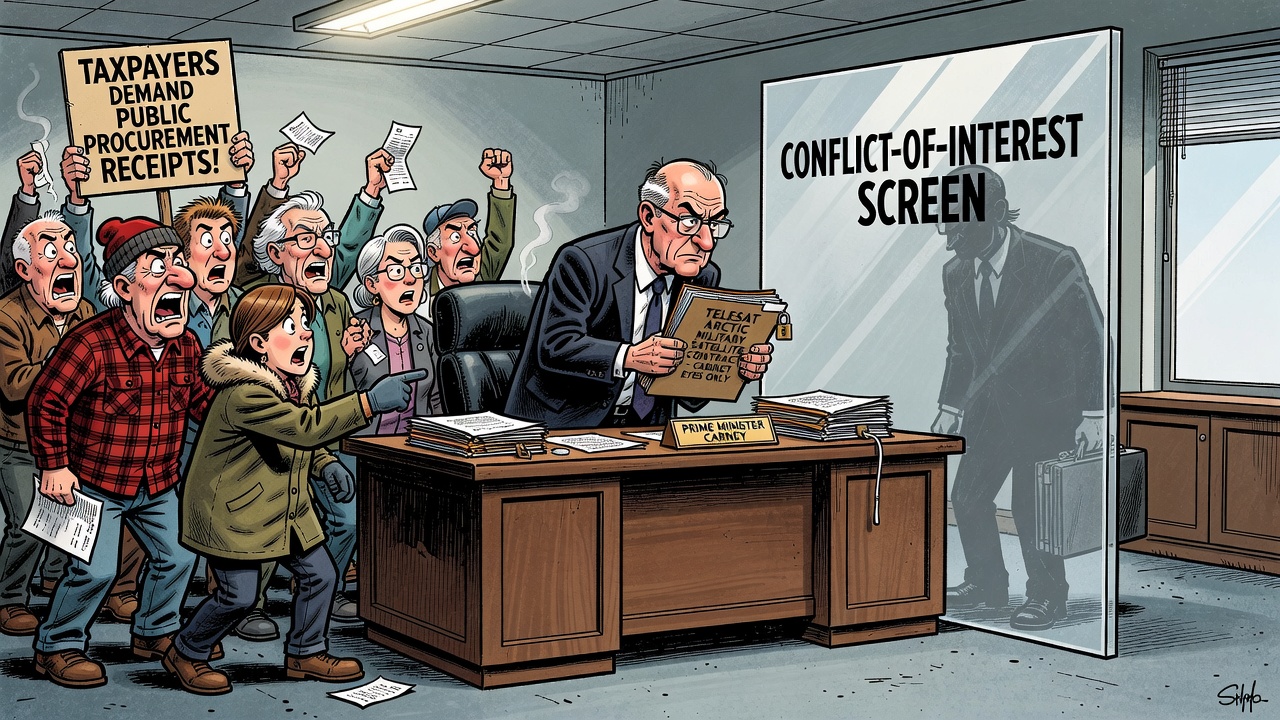
National-security contracts do not get a free pass from accountability. They deserve tighter oversight because secrecy is sometimes necessary — and because secrecy can also hide weak procurement, insider access or political convenience.
That is the problem with Ottawa’s Telesat deal. In July, the federal government announced what it called a strategic agreement with Telesat to provide Canadian Armed Forces access to the company’s Lightspeed low-earth-orbit satellite network, describing the value as $2.3 billion. The announcement framed the arrangement as Arctic communications, sovereignty and defence modernization. Those are legitimate objectives. They are not a substitute for receipts.
CBC reported that Conservatives are questioning the agreement because Telesat’s CEO, Dan Goldberg, is a personal friend of Prime Minister Mark Carney. The Prime Minister’s Office has said there was an ethics screen, according to the same reporting. That may be true. But Canadians should not have to accept a one-line reassurance when public money, military capability and a politically sensitive personal relationship intersect.
A conservative accountability standard is simple: do not allege corruption without evidence, but do not treat “trust us” as evidence either. If the contract is clean, the government should be able to publish a redacted conflict-screen ledger showing who identified the potential issue, when the screen was created, which files Carney was barred from, which officials had decision authority, and whether any communications with Telesat or Goldberg were logged and reviewed.
The same applies to procurement value. National security may justify redacting technical details, satellite vulnerabilities or military-use specifics. It does not justify hiding the basic commercial architecture from taxpayers: what is firm spending, what is optional, what performance milestones unlock payments, what cancellation rights exist, what domestic work is guaranteed, and what happens if the technology is delayed or underperforms.
Ottawa has spent years asking Canadians to accept emergency apps, sole-source habits, green-bank cheques and procurement black boxes on faith. Defence is too important for that culture. Arctic communications matter. Sovereignty matters. So does proving that a well-connected vendor was selected because it offered the best defensible deal, not because cabinet could bury awkward questions behind a national-security label.
The government should publish a redacted Telesat receipt package: procurement rationale, option values, payment triggers, security redactions, conflict-screen dates, delegated decision-makers, meeting logs, lobbyist contacts, and independent legal or ethics sign-off. Parliament’s defence and ethics committees should be able to review fuller records in camera if public release would expose sensitive capability details.
If the Carney government wants Canadians to believe this is a serious defence investment, it should welcome that test. The standard is not scandal-first politics. The standard is proof-first government.
- CBC News: Conservatives question whether government deal for military satellites favours Liberal friend
- Government of Canada: Strategic agreement with Telesat for a new low-earth orbit satellite constellation
- Conflict of Interest and Ethics Commissioner: Summary of rules for public office holders
This article argues for procurement transparency and conflict-screen disclosure. It does not allege that Telesat, Dan Goldberg or any public official has been found to have acted improperly.