Carney’s Failed Trade Deal Needs a Public Concession Ledger
After Canada-U.S. trade talks collapsed, Ottawa owes Canadians the concession list: autos, alcohol, supply management, language rules and every red line.
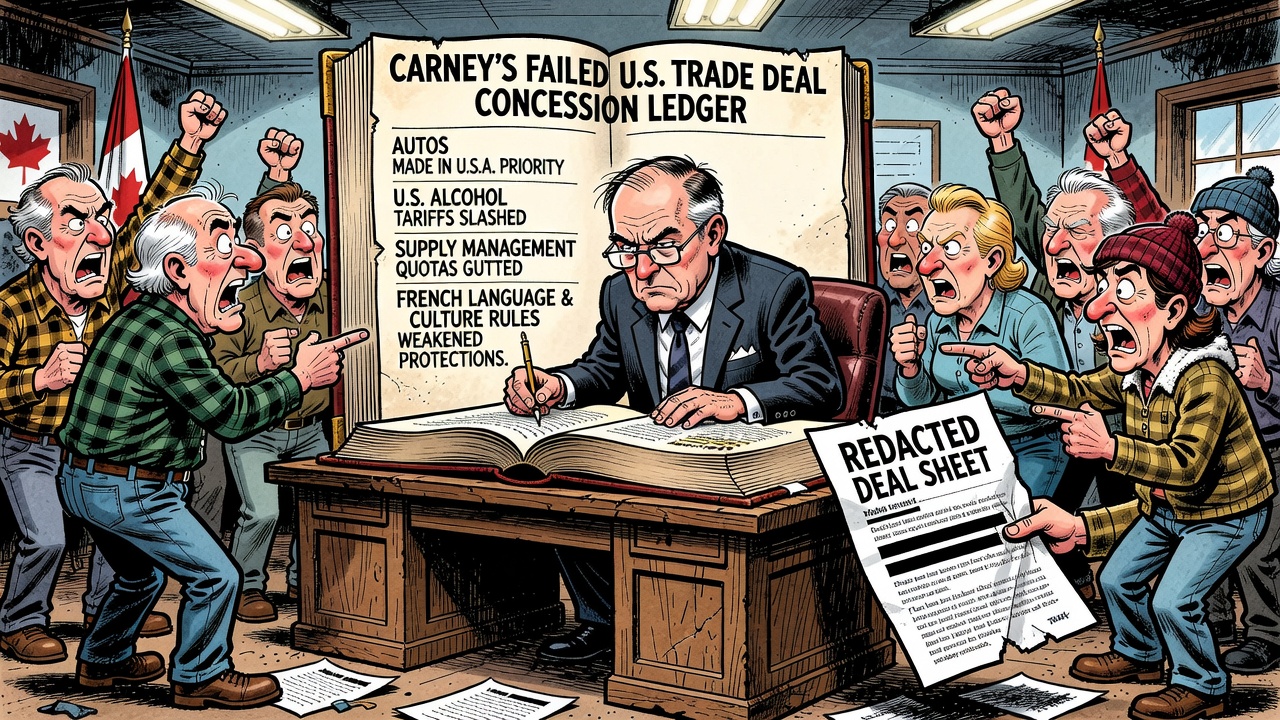
Prime Minister Mark Carney says he walked away from a bad Canada-U.S. trade deal. That may be true. It is also incomplete.
Canadians are now being asked to absorb a deeper trade war while Ottawa keeps the public guessing about what was actually on the table. Carney’s own August 22 remarks confirmed Canada had been prepared to drop remaining retaliatory tariffs on strategic sectors — particularly steel, aluminum and autos — if the United States substantially lowered its own. He also said Ottawa would have encouraged provinces to return American alcohol to shelves and would have taken administrative measures on supply management without changing the system, quotas or applicable tariffs.
Those are not trivial details. They are concessions, or at least proposed tradeoffs, in areas that affect workers, farmers, provincial governments and consumers. If they were wise, publish the rationale. If they were necessary, publish the evidence. If they were rejected because Washington demanded too much, show Canadians the redacted deal sheet.
Global News reported that Carney identified three late-breaking issues that helped crater the talks: auto-tariff treatment, U.S. attempts to restrict Canada’s ability to make trade deals with other countries, and protections for Canadian culture and French-language rules. The same report said Carney had shared potential-deal details with premiers earlier in the week and asked them to begin selling American alcohol again as part of the agreement.
This is where conservative accountability matters. No serious Canadian should cheer U.S. tariffs on our workers. No serious government, however, should use a foreign bully as an excuse to hide its own negotiating record. Ottawa can protect sensitive tactics while still publishing categories of concessions, sector impacts, legal risks, provincial asks and the red lines it says it defended.
The culture and language file is especially opaque. Carney said Canada would not compromise protections for French language and culture. Global noted Republicans have previously criticized Canada’s Online Streaming Act as discriminatory. That does not prove the Act was in the final text. It does prove the public deserves clarity on whether streaming rules, Quebec language law, cultural protections or digital policy were used as leverage in a tariff bargain.
Carney campaigned as the competent adult in the room. Competence is not a press conference after talks collapse. It is a public record sturdy enough to survive scrutiny.
Publish the concession ledger: Canadian offers, U.S. demands, auto and heavy-truck treatment, alcohol commitments requested of premiers, supply-management administrative changes, culture and language provisions, digital-policy references, sectors left exposed, expected household costs and the plan to reopen talks.
If rejecting the deal protected Canada, the receipts should help Carney. If the receipts are embarrassing, Canadians need them even more.
- Prime Minister of Canada: Prime Minister Carney delivers remarks on Canada-U.S. trade negotiations
- Prime Minister of Canada: Prime Minister Carney chairs First Ministers’ Meeting
- Global News: U.S.-Canada trade talks have collapsed. Carney says these 3 issues torpedoed them
- Associated Press: What to know about new Trump tariffs on Canadian products and rising trade tensions
This article argues for disclosure of non-security-sensitive trade records. It does not claim all negotiating documents can be released unredacted or that every issue reported was included in final legal text.