The NATO Spy Probe Needs a Public Vetting Chain Ledger
Parliament finally has a hearing path. Now Ottawa should publish the non-operational chain: sponsor, clearance standard, agencies, known red flags, handoffs and fixes.
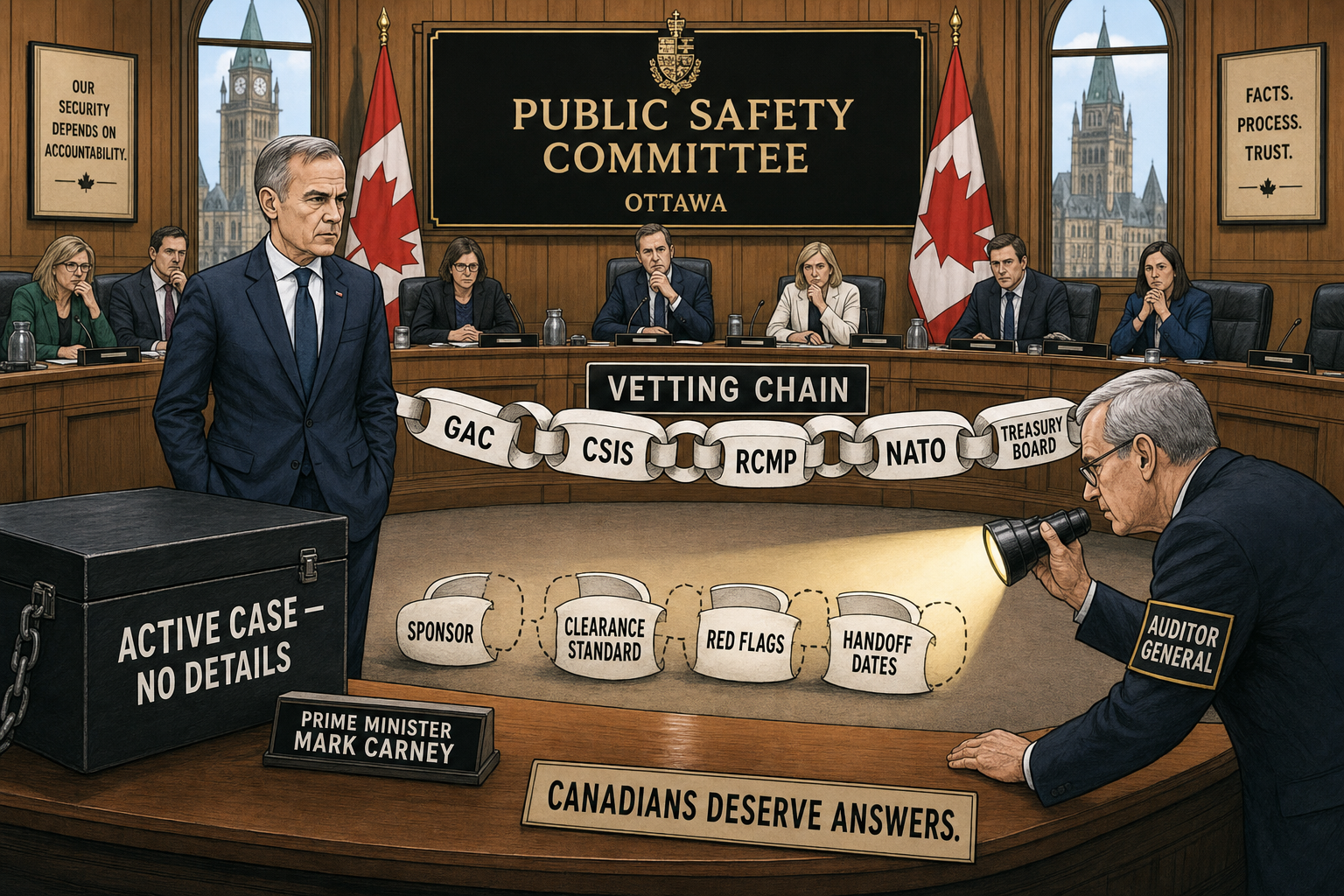
The NATO intern espionage case is not a licence for racial suspicion. It is a test of whether the Carney government can explain Canada’s security-screening system without hiding the whole file inside a black box.
The hard facts are serious enough. The Associated Press reported that Belgian authorities arrested a Canadian woman accused of espionage while working as an intern at NATO’s Supreme Headquarters Allied Powers Europe in Mons. Belgian prosecutors said she was suspected of spying for a third country and participating in a criminal organization. Those allegations have not been proven in court, and any public response must keep that presumption of innocence front and centre.
But institutional accountability does not have to wait for a criminal verdict. Canadian Press reporting carried by CityNews said Prime Minister Mark Carney told reporters Canadian officials had been “involved from the start,” while saying he could not give details because the case was active. Defence Minister David McGuinty also avoided case specifics, while saying the government is working to improve security clearances for sensitive positions and defence-contractor work.
That is not enough. If Canadian officials were involved from the start, Canadians are entitled to know what “involved” means in non-operational terms. Which department sponsored the placement? What clearance standard applied? What role did Global Affairs Canada play? What role did CSIS, the RCMP or other screening bodies play? What records were checked, what handoff dates existed, and who had authority to accept or override concerns?
The vetting question is sharper because CityNews also reported that court records said the Public Service Commission found in 2023 that Biwei Zhang, also known as Claire Zhang, committed fraud in an appointment process for a Canada Border Services Agency position, and that Federal Court later dismissed her judicial-review application. If that public-record finding was visible before the NATO placement, Parliament should ask exactly where it entered the screening file and how it was weighed.
MPs now have the right forum. The Bureau reported that members of the House public safety committee unanimously agreed to hold fall hearings into Canada’s national-security clearance and vetting system after the arrest. A National Post item mirrored on NDP MP Jenny Kwan’s site said the committee probe is expected to examine vetting by Canadian security officials before the NATO internship, and Kwan called for review of Global Affairs Canada, CSIS and the RCMP while warning screening must not become racial or ethnic profiling.
That warning matters. Conservatives should be relentless about foreign interference and equally clear about civil liberties. The target is not ethnicity. The target is process failure: incomplete files, ignored public records, unclear sponsorship, weak handoffs, vague ministerial answers and no public lessons learned.
The fix is a public vetting-chain ledger. It should disclose, without operational secrets, the sponsoring department, clearance category, agencies consulted, date ranges, categories of records reviewed, known red-flag categories, escalation rules, allied-notification rules, post-incident remediation and the official accountable for each link. If Ottawa can ask allies and taxpayers to trust its screening, it can show the chain.
- Associated Press: Canadian arrested on suspicion of spying inside NATO military headquarters
- CityNews / Canadian Press: Poilievre says Carney must explain screening that led to NATO spy case
- The Bureau: Ottawa opens probe into NATO intern vetting
- Jenny Kwan, MP / National Post mirror: Public safety committee votes to investigate vetting of accused NATO spy
This article addresses institutional vetting and public accountability. It does not claim the criminal allegations have been proven and rejects racial or ethnic profiling.