Canada’s Archives Black Box Needs a Public Declassification Ledger
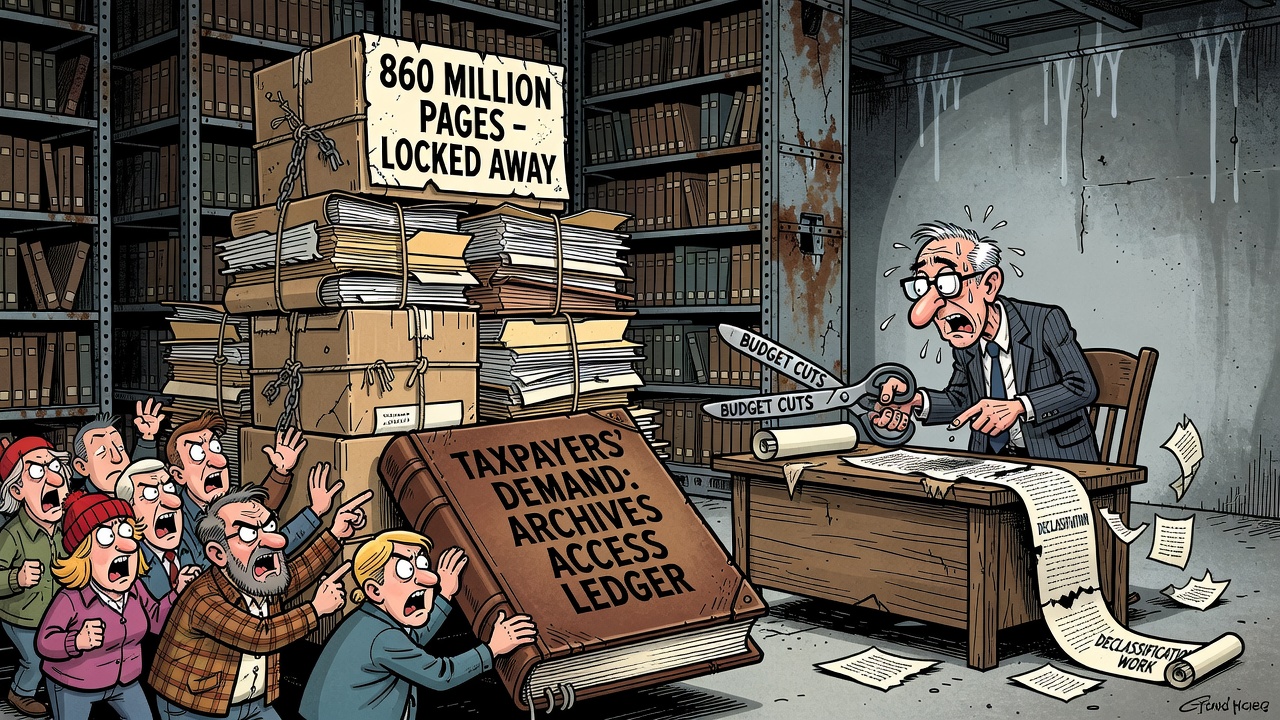
Nearly 860 million pages of historical records are reportedly still inaccessible at Library and Archives Canada while proactive declassification work has ended. That is not transparency. It is a backlog with a flag on it.
Governments love the word transparency when it costs nothing. The real test comes when transparency requires staff, deadlines, scanning, declassification decisions and political discomfort. By that test, Ottawa’s archive problem is a serious failure.
Rebel News, citing internal federal documents obtained by Blacklock’s Reporter, says nearly 860 million pages held by Library and Archives Canada remain inaccessible to the public. The reported April 21 Comprehensive Expenditure Review note put the closed share of the federal archives at 78%, leaving only about a quarter of records accessible online or in person. That is not a small processing delay. It is a national memory bank operating like a vault.
The official record confirms the basic problem even without the leaked note. Library and Archives Canada’s own evaluation of private archives says unprocessed material in the backlog “remains inaccessible to Canadians” and that long-term preservation is at risk. In plain English: records Canadians already paid to collect and preserve can still sit beyond reach because the system has not processed, described, reviewed or opened them.
There has been progress, and it should be acknowledged. LAC’s June 2026 ATIP progress report says its Reappraisal and Block Review of Government Records Team opened 12,333,477 pages of archival records in 2025–26, far above its three-million-page objective. The same update says LAC reduced its overdue-request backlog by about 42% compared with the previous fiscal year. Those numbers show that reform is possible when the work is funded, tracked and managed.
But the same progress report contains the red flag: proactive declassification activities have ended because of Comprehensive Expenditure Review reductions. That is exactly backwards. If Ottawa is serious about access to information, it should not wind down the function that helps old records move faster through security handling, digitization and release. It should publish the queue.
A conservative accountability standard is simple: taxpayers paid for the records, taxpayers paid for the archivists, and taxpayers are entitled to a public plan for access. Not every file can be opened tomorrow. Privacy, national security and cabinet confidence rules exist for reasons. But secrecy by inertia is still secrecy. A record that stays closed because no one has processed it is not being protected by law; it is being hidden by administrative neglect.
Ottawa should publish an archives-access ledger: total closed pages by department, oldest unopened collections, declassification queue, annual page-opening targets, staffing levels, CER cut impacts, digitization bottlenecks, consultation delays and exemptions used. If 860 million pages are still behind the wall, Canadians deserve to know what is there, who controls the keys and when the doors open.
- Rebel News: Feds keep 860 million pages of historical records inaccessible to Canadians
- Library and Archives Canada: Evaluation Report on the Processing of Private Archives (2015–2020)
- Library and Archives Canada: June 2026 ATIP action plan progress report
- Treasury Board Secretariat: Comprehensive Expenditure Review committee briefing
This article does not argue that every restricted record can be released immediately. It argues that Ottawa must disclose the backlog, declassification, staffing and release-target receipts so lawful restrictions do not become indefinite administrative secrecy.