Bradford’s $94.8M Housing Deal Needs Unit-by-Unit Delivery Receipts
If governments claim one cheque can unlock more than 29,000 homes, Canadians deserve the public math.
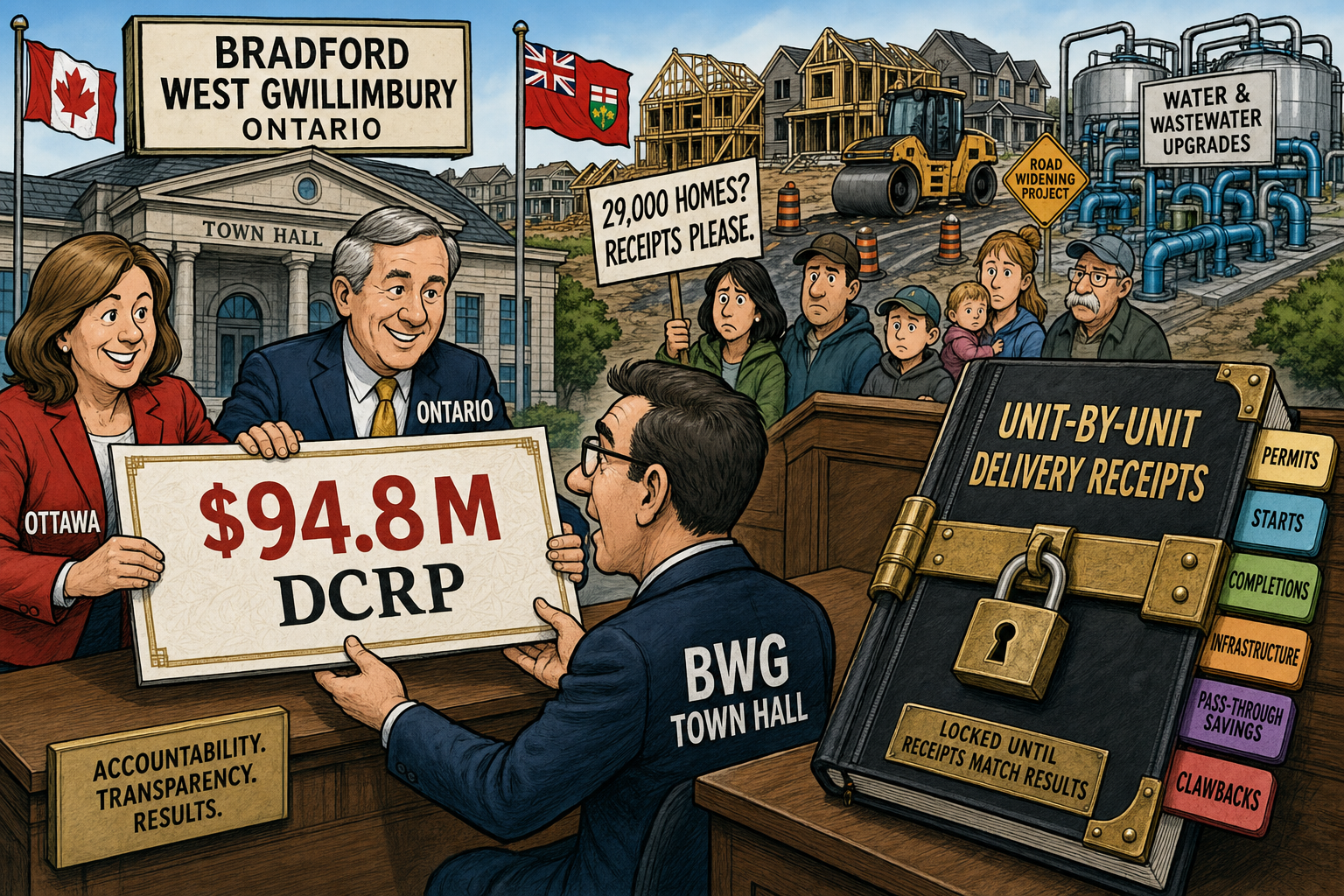
Canada and Ontario announced up to $94.8 million for the Town of Bradford West Gwillimbury through the Development Charge Reduction Program. The deal is presented as a housing-affordability bargain: the town reduces development charges for three years, and governments help fund the infrastructure needed for growth.
That sounds practical. It also sounds like exactly the kind of announcement that can vanish into ribbon-cutting language unless taxpayers get receipts. The public has been promised a very specific trade: lower upfront charges, infrastructure money, and more homes. Now the public should be able to track whether that trade actually happens.
The official release says Bradford West Gwillimbury committed to reduce development charges by up to 76 per cent, depending on unit type and area, from March 30, 2026, to March 31, 2029. It estimates the reductions could cut new-home building costs by up to $36,500 per home. When combined with expanded HST relief on eligible new homes, the release says savings could reach up to $166,500.
The biggest number is the one that requires the toughest audit. Bradford West Gwillimbury estimates the charge reductions, combined with housing-enabling infrastructure investment, would unlock more than 29,000 new homes. That is not a slogan; it is a claim that can be measured.
So measure it in public. Publish the transfer agreement. Publish the eligible project list, budgets, timelines, procurement status and completion dates. The named infrastructure work includes upgrades to Plant D at the Bradford Water Pollution Control Plant, added municipal water storage at the John Fennell Reservoir, Line 8 corridor widening and reconstruction from Sideroad 10 to Barrie Street, and new Church Well infrastructure. Each project should have a cost line, schedule and housing-capacity assumption attached to it.
Then publish the unit ledger: monthly permits, starts, completions, unit type, location, development-charge discount applied, and the estimated per-unit savings. If the public is told builders save up to $36,500 per home, taxpayers should also see evidence that those savings improve buyer or renter affordability instead of simply improving project margins.
The conditions matter too. The release says federal funding is subject to a Canada-Ontario Build Communities Strong Fund agreement, federal review and approval, an Ontario-municipal transfer payment agreement, program compliance, and a minimum 10 per cent municipal contribution. Those conditions should not sit behind closed doors. They should be posted with plain-language pass/fail status updates.
No serious conservative objects to roads, water systems or housing-enabling infrastructure. But serious conservatives should object to housing announcements that count hypothetical homes before the first public delivery receipt is filed. If Ottawa and Queen’s Park want credit for affordability, they should accept accountability for outputs.
The test is simple: no more housing press releases without unit-by-unit receipts.
- Housing, Infrastructure and Communities Canada: Canada and Ontario Making Homes More Affordable in Bradford West Gwillimbury
- Ontario Newsroom: Ontario and Canada Making Homes More Affordable in Bradford West Gwillimbury
This article argues for stronger public disclosure and value-for-money controls. It does not allege that Bradford West Gwillimbury, Ontario, Canada or any public official acted unlawfully.