Beijing’s Applause for Carney’s Tariff Playbook Needs a Red-Line Ledger
Chinese state media praise is not proof of interference. It is a reason to publish the tariff, China red-line and foreign-influence receipts.
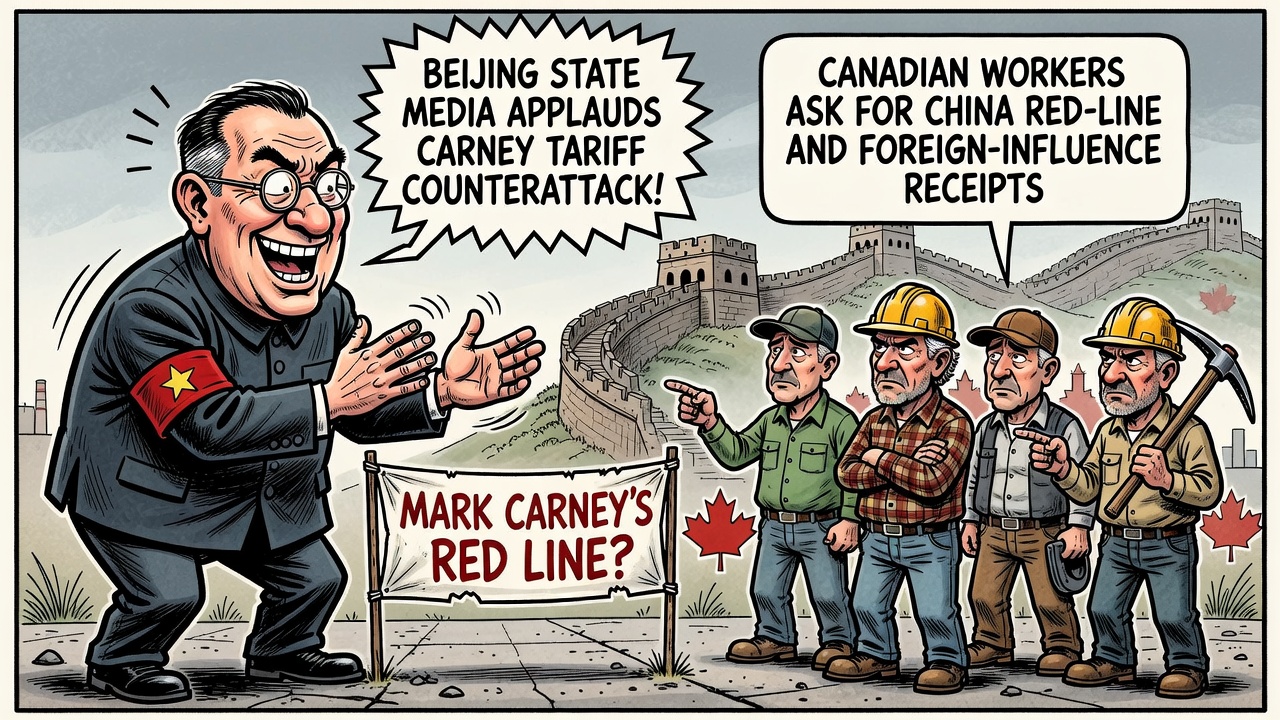
When Beijing’s state media starts applauding a Canadian prime minister’s trade strategy, Ottawa should not panic. It should publish receipts. Global Times, a Chinese state-run outlet, framed Canada’s latest tariff fight as a “Chinese-styled counterattack” and praised a dollar-for-dollar retaliation plan against Washington. That is not proof of foreign interference. It is a warning light for democratic accountability.
The issue is not whether Canada may defend its workers against unfair U.S. pressure. Of course it can. A serious country protects steel, agriculture, manufacturing and resource communities when allies or rivals threaten them. The issue is whether Prime Minister Mark Carney’s government can show Canadians that its tariff strategy is driven by Canadian interests, not by a short-term communications need or by Beijing’s preferred anti-American narrative.
The Global Times editorial celebrated Canada’s approach as a blow against U.S. pressure and described retaliatory tariffs expected to hit sectors including steel, dairy, home appliances, agricultural equipment, pulp and paper, and electronics. AP reporting also described a rapidly deteriorating Canada-U.S. trade fight, with Ottawa preparing retaliation after Washington escalated and Carney accused the United States of trying to subordinate Canada.
That makes the disclosure test straightforward. Ottawa should publish the tariff ledger: the economic modelling behind each targeted sector, the projected consumer costs, the expected job protection, the retaliation risk, the exemption process, and the benchmark for declaring success or failure. If families and businesses are expected to absorb higher prices for a strategic purpose, they deserve to know the strategy.
The China file requires an even brighter light. Canada’s foreign-influence registry came into force on August 4, 2026, with 14-day registration duties for certain arrangements involving foreign principals and penalties that can reach $1 million. If the registry is meant to protect Canadian democracy, the government should pair it with a China red-line ledger: enforcement staffing, investigation timelines, diaspora-safety safeguards, cabinet briefings, meetings with state-linked actors and any trade concessions under discussion.
A conservative accountability perspective does not require treating every Chinese-Canadian community group, business contact or foreign-policy disagreement as suspect. It requires the opposite: clear rules, public thresholds and equal enforcement so innocent Canadians are not smeared while real influence operations are not hidden behind diplomatic fog.
Carney’s problem is credibility. He sells himself as the adult in the room, the global finance expert who can manage volatility. Fine. Then he should welcome a paper trail. If Beijing’s propaganda apparatus sees advantage in Canada’s tariff posture, Canadians should see exactly how Ottawa separated national interest from geopolitical theatre.
No more black-box trade strategy. Publish the tariff rationale, China red lines, registry enforcement plan, sector-by-sector cost estimates and cabinet accountability chain. Canada can stand up to Washington without becoming a talking point for Beijing. But the government has to prove it with receipts.
- Global Times: Canada launches a Chinese-styled counterattack — a heavy blow
- Associated Press: Canada prepares retaliatory tariffs in escalating trade fight
- Rebel News: Chinese state media praises Carney tariff approach
- Juno News: Chinese state media praises Carney’s tariff strategy
- Public Safety Canada: Government establishes foreign influence registry
This article does not allege Chinese state-media praise proves interference. It argues that public praise from a foreign state outlet creates an accountability case for more transparency from Ottawa.