Carney’s $4.7B VIA Rail Deal Needs a Delivery Ledger
A Buy Canadian press conference is not a procurement audit. If Ottawa is spending billions on rail cars, Canadians deserve delivery dates, cost controls and jobs proof.
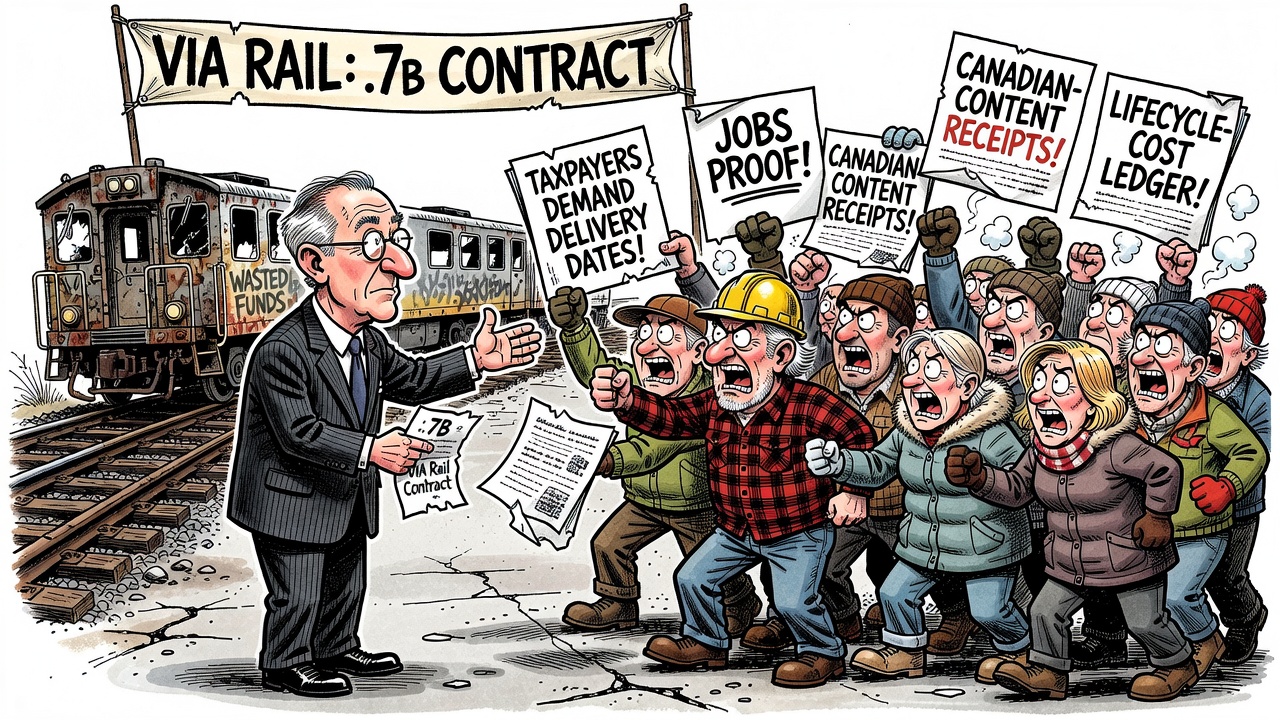
Prime Minister Mark Carney announced on September 3 that Ottawa will invest more than $4.7 billion for VIA Rail to acquire and maintain 313 new passenger rail cars from Alstom Canada. The cars are to be manufactured and assembled in Thunder Bay, Ontario, and La Pocatière, Quebec, with design and engineering work in Saint-Bruno-de-Montarville, Quebec.
There is a serious pro-rail argument here. VIA’s long-distance, regional and remote fleet is old; the PMO says some equipment is more than 70 years old. If Canadians are going to keep national passenger rail service for communities outside the Quebec City-Windsor corridor, rolling stock eventually has to be replaced. Building more of it in Canada is better than defaulting to foreign supply chains.
But that is exactly why this file needs a ledger, not a victory lap. The government calls this the largest investment in VIA Rail’s history and says it will support nearly 700 jobs while generating more than $1.6 billion in economic benefits. Those are political selling points. Taxpayers need to see the contract terms behind them.
Start with cost. A rough division of $4.7 billion by 313 cars puts the package near $15 million per car, although Ottawa says the money covers acquisition and maintenance, not just the vehicles. That distinction matters. If maintenance is bundled, Canadians should know the lifecycle period, inflation assumptions, warranty terms, spare-parts obligations, service standards and what happens if performance falls short.
Then delivery. Canadian Press reporting says Transport Minister Steven MacKinnon told reporters the first new car should be delivered in 2031, and the government’s earlier locomotive-and-facility spending is also tied to 2031 delivery expectations. That is five years away. A five-year promise requires public milestones now: design freeze, plant readiness, supplier certification, first article inspection, acceptance testing, route deployment and penalties for delay.
The jobs claim needs the same treatment. “Nearly 700 jobs” is not a receipt. Are those net new jobs or retained positions? How many are permanent, how many are temporary, and how many are directly funded by the contract? What share of steel, components, engineering hours and maintenance work must actually be Canadian? Which suppliers are included, and how will Ottawa verify the Buy Canadian claim after the cameras leave Thunder Bay?
Conservatives should not oppose every rail investment by reflex. Remote and regional service matters, and Canadian manufacturing capacity matters. The accountability test is whether the Carney government can prove this is disciplined procurement rather than industrial-policy theatre.
Publish the contract summary, payment schedule, delivery milestones, Canadian-content definition, supplier list, job-verification method, lifecycle-cost model and clawback terms. If this deal is as strong as Ottawa says, the ledger should strengthen the case. If the ledger stays hidden, Canadians should treat the headline as a down payment on questions still unanswered.
- Prime Minister of Canada: Prime Minister Carney announces the largest investment in VIA Rail’s history — September 3, 2026
- CityNews / Canadian Press: Ottawa spending $4.7B on new made-in-Canada VIA Rail passenger cars
- Global News: VIA Rail cars to be made in Canada for 1st time in 40 years, Carney says
This article supports transparent rail procurement and Canadian industrial capacity while criticizing undisclosed cost, delivery, jobs and lifecycle-risk details.