Carney’s Tariff Response Is Becoming an $8.7B Subsidy Ledger Test
Tariff pain is real. So is taxpayer risk. Canadians deserve the receipts before another emergency package becomes permanent industrial policy.
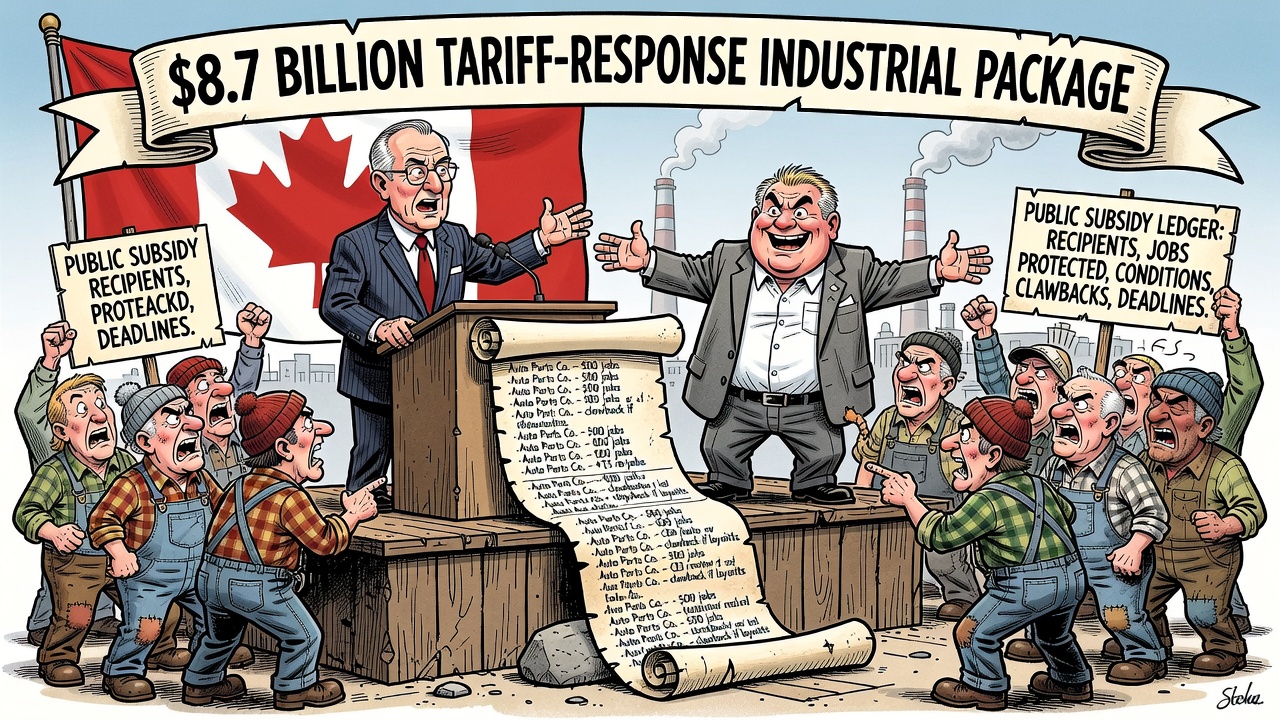
Prime Minister Mark Carney and Ontario Premier Doug Ford have announced an $8.7 billion action plan for tariff-affected industries. The government’s case is straightforward: U.S. tariffs have damaged an integrated North American economy, Ontario is Canada’s manufacturing heartland, and steel, autos and critical minerals need protection while the trade war drags on.
That may be true. It is also exactly why the public needs a subsidy ledger before the cheques turn into another Ottawa habit.
The federal announcement says the package includes a Joint Steel Action Fund with five-year commitments of $3.55 billion from Ottawa and $1.67 billion from Ontario. It also promises Buy Canadian and Buy Ontario procurement preferences, tougher enforcement against dumping, and a steel task force. For autos, the plan adds $2.5 billion over two years for capital projects, with $1.5 billion federal and $1 billion provincial. For the Ring of Fire, Ottawa will match Ontario’s initial road-infrastructure investment of up to $1 billion over three years.
Those are not rounding errors. They are major public commitments layered on top of earlier federal tariff supports. The Prime Minister’s Office says Ottawa has already provided more than $25 billion in support to workers and businesses affected by U.S. tariffs, and announced another $7.5 billion in new and enhanced measures in August 2026. At some point, “temporary response” becomes an industrial strategy paid for by taxpayers who were never shown the invoice.
Conservatives do not need to minimize the tariff threat to demand discipline. If Washington is trying to pull auto production south and squeeze Canadian steel, government should defend Canadian workers. But defence is not the same as a blank cheque. Every recipient, condition and promised outcome should be public by default unless a narrow, time-limited commercial reason justifies redaction.
The ledger should answer basic questions: Which firms receive money or loan support? How many jobs are protected, created or retrained? What capital investment is required from the company? What executive bonuses, dividends or share buybacks are restricted while public money is at risk? What export diversification target must be met? What happens if a firm takes support and still moves production, misses hiring commitments or sells the subsidized asset?
Carney’s government likes to describe this moment as building a stronger, more independent economy. Fine. Independence should not mean replacing dependence on U.S. markets with dependence on Ottawa’s discretion. If the plan is smart, publish the scorecard. If it is political triage, Canadians should see that too.
- Prime Minister of Canada: Prime Minister Carney and Premier Ford launch new action plan to protect workers from tariffs and strengthen Ontario industries
- Associated Press: Carney says Trump’s tariffs hurt Americans as US alleges Canadian interference
- Government of Canada: Canada announces targeted countermeasures and substantive support for workers and businesses in response to U.S. tariffs
This article does not dispute that tariffs can harm Canadian workers and firms. It argues that large emergency industrial supports require transparent recipient-level accountability.