Record Food Bank Visits Expose Ottawa’s Affordability Failure
A government can brand a grocery benefit. It cannot brand away 2.35 million food bank visits in a single month.
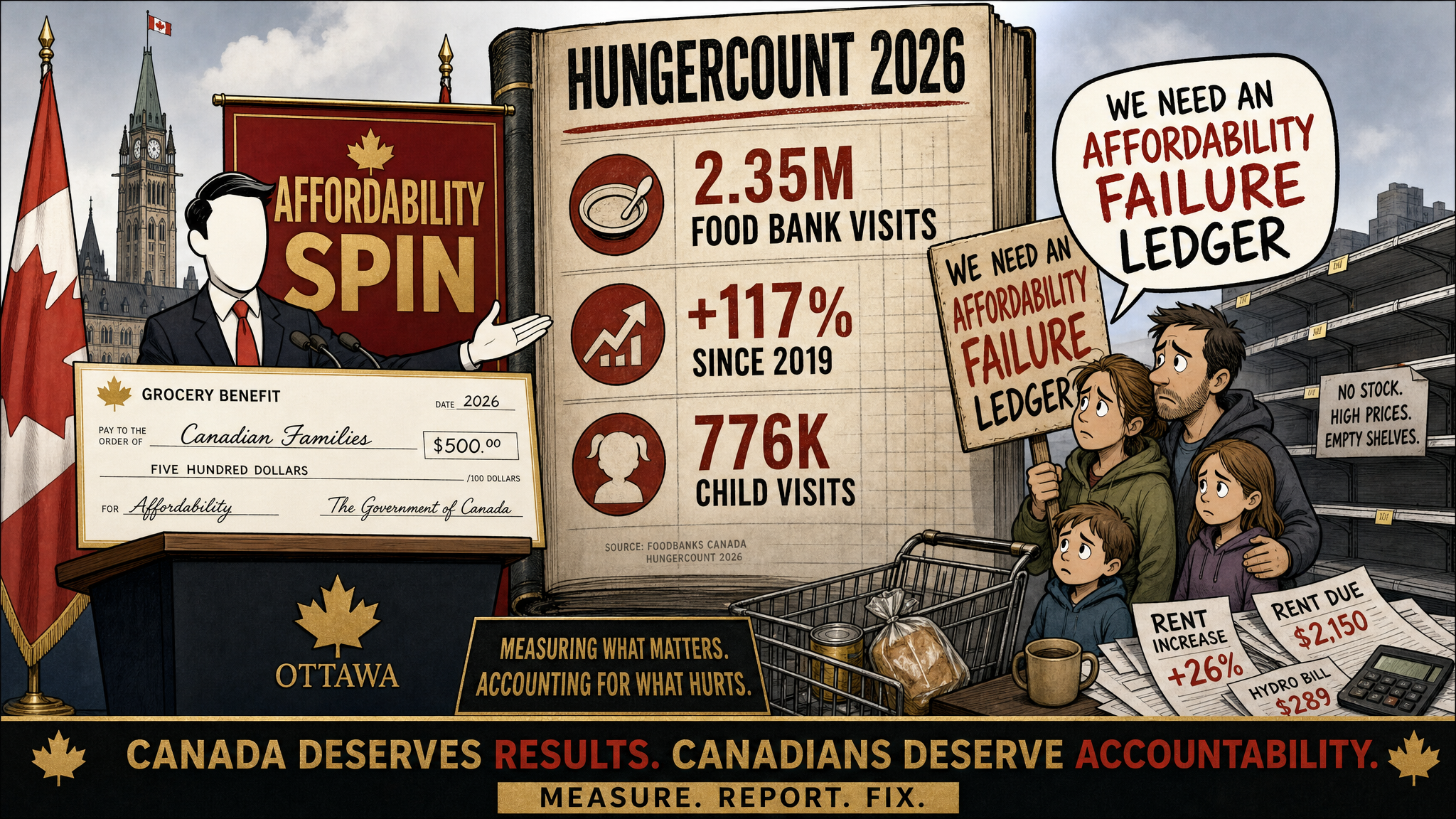
Food Banks Canada’s 2026 HungerCount is the affordability report card Ottawa cannot spin. In March 2026, food banks recorded 2,355,075 visits in one month — the highest total in the report materials, up 8.7% from 2025 and 116.8% from 2019. That is not a communications problem. It is a governing failure measured in grocery lines.
The child numbers are even harder to dismiss. Food Banks Canada says children accounted for 32.5% of clients, representing 775,658 monthly visits. Nearly one in five clients reported employment as their main source of income, compared with about 12% in 2019. In plain English: for too many working Canadians, a paycheque no longer guarantees enough food after rent, transportation and basic bills.
The report’s diagnosis is brutally direct. It points to years of rising housing costs, insufficient housing supply, food inflation, economic uncertainty and inadequate income supports eroding household resilience. Since 2021, it says food prices rose by roughly 30%, housing costs by 28% and transportation costs by nearly 24%. Meanwhile, 71.8% of food bank clients live in market rental housing, putting the housing crisis at the centre of the hunger ledger.
That is why Ottawa’s affordability messaging deserves a receipts test. The Canadian Press report carried by CityNews noted that Food Banks Canada CEO Kirstin Beardsley called the federal Canada Groceries and Essential Benefit a positive investment, but not nearly enough to close the gap she is seeing at the community level or in northern regions. A benefit announcement may help some households. It does not erase record food bank demand, child hunger or the growing share of employed clients using emergency food support.
Food Banks Canada’s own recommendations are concrete: modernize Employment Insurance, double the Canada Workers Benefit, remove disability-support barriers, review the adequacy of social assistance, invest in food-access infrastructure, and reform Nutrition North Canada with clearer affordability targets and public reporting. Ottawa does not have to accept every recommendation exactly as written. But it does owe Canadians a measurable plan.
So publish the affordability failure ledger. Show the grocery-benefit cost, eligibility, expected reach, regional uptake, northern supplement math, rent burden, child food-bank visits, working-client share and targets for reducing food-bank reliance. Tie the spending to outcomes. Put dates beside every promise. If a program is working, prove it. If it is not, fix it.
Conservative accountability starts with refusing to let slogans substitute for results. Canada’s food-bank network has produced the receipt: 2.35 million visits in a month. Now Ottawa should produce its own.
- Food Banks Canada: HungerCount 2026 overview and national data
- Food Banks Canada: HungerCount Report 2026
- CNW / Food Banks Canada: Canada’s 2026 HungerCount finds millions face impossible trade-offs
- Canadian Press via CityNews Vancouver: Canadian food bank use hits 2.3 million monthly visits due to grocery costs
This article uses HungerCount 2026 as an accountability benchmark for federal affordability policy. It does not claim federal policy is the only driver of food-bank demand.