Ottawa’s Internet Review Needs an Online-Powers Ledger
Child protection is not a blank cheque for hidden internet-power planning. Publish the mandate before another legal-content regime moves forward.
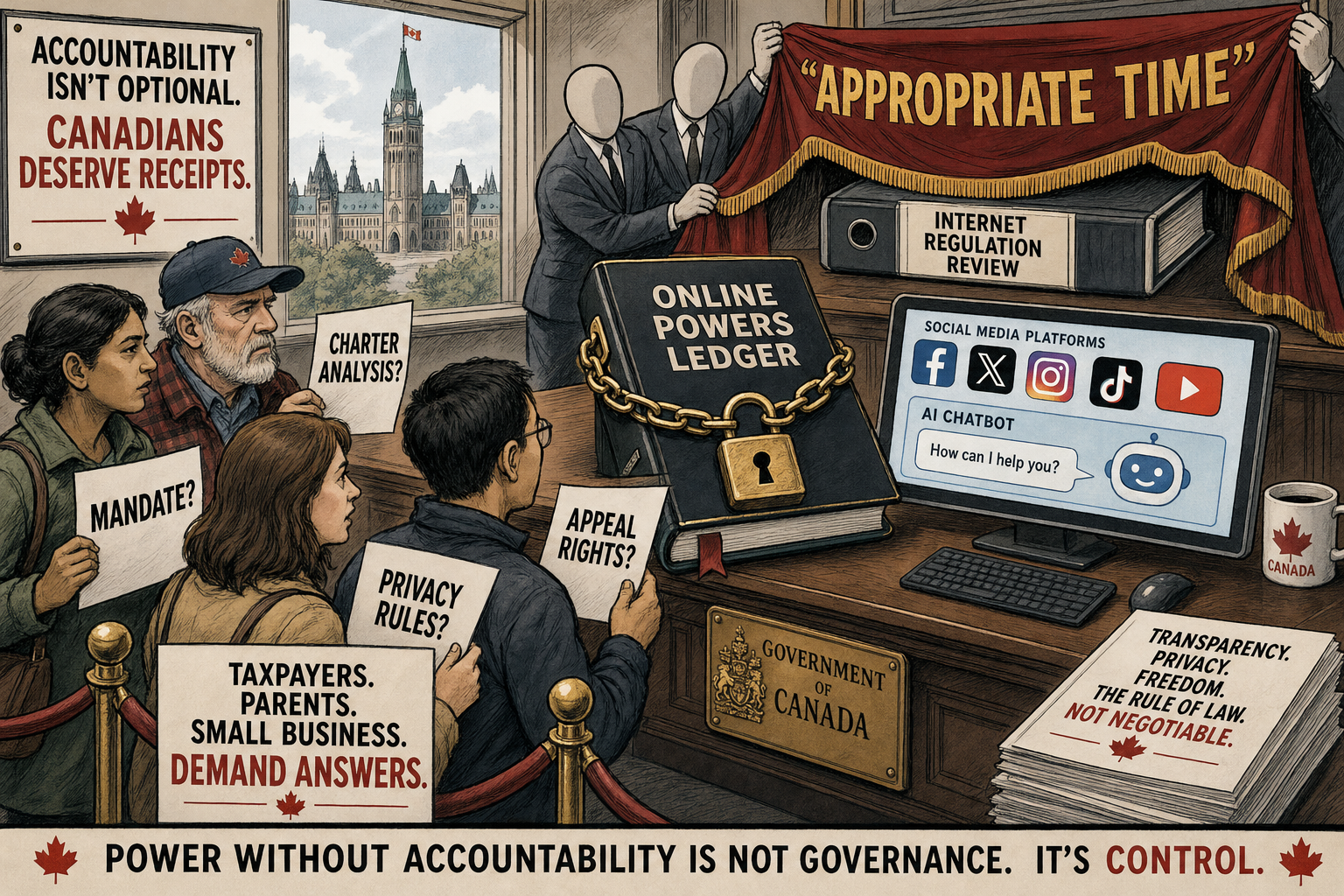
Blacklock’s Reporter’s public archive says cabinet is reviewing federal regulation of legal internet content for a third time in five years. The Department of Industry’s answer, according to the archive, was that details would be made public “at the appropriate time.” That is exactly backwards. If Ottawa is again studying lawful online expression, the appropriate time for basic transparency is now.
This is not happening in a vacuum. Canadian Heritage says Bill C-34, introduced June 10, 2026, would enact the Digital Safety Act and the Digital Safety Commission of Canada Act. The government says the bill would cover regulated social-media services and certain AI chatbot services, impose a duty to protect children, and build enforcement through a new Digital Safety Commission.
The same official materials show why a separate online-powers ledger matters. Bill C-34’s highlights say children under 16 would not be permitted to have accounts on certain social-media services unless a service receives an exemption from the Commission. They also say AI chatbot services would need child-protection design features that will be outlined by the Commission. In plain English: Parliament is being asked to approve a framework while major operating rules are still to be written later.
The Charter problem is not hypothetical. The Department of Justice’s Charter statement says the bill’s account restriction can engage freedom of expression because it affects users’ ability to post and consume content. CityNews, reporting Canadian Press coverage on October 21, said the government also acknowledged possible effects on equality rights and privacy, while arguing the bill remains Charter-consistent.
That may be the government’s legal position. It is not a substitute for public receipts. When a bill touches expression, privacy, age verification, platform duties, chatbot rules, exemptions, penalties and a new regulator, Canadians should not have to wait for an unnamed “appropriate time” to learn what other legal-content powers are being reviewed behind the curtain.
Treasury Board’s own regulatory-transparency policy points in the opposite direction from secrecy. Departments are supposed to provide advance notice of upcoming regulatory changes, expected impacts, consultation opportunities and contacts through forward regulatory plans. If Ottawa is considering another internet regulation track, that work belongs in public view, not in a departmental file Canadians discover after the options are already narrowed.
The conservative accountability test is straightforward: protect children, prosecute crime and leave lawful political debate alone unless Parliament has clearly authorized a narrow, reviewable rule. Publish the ISED review mandate, legal authorities under consideration, affected services, stakeholder meetings, Charter and privacy analysis, consultation schedule, Commission powers, appeal rights, penalty ranges and safeguards. If the government’s plan is reasonable, it can survive daylight. If it cannot survive daylight, it should not become Canada’s next internet law.
- Blacklock’s Reporter archive: Third Try At Web Regulation
- Canadian Heritage: Bill C-34, the Safe Social Media Act
- Canadian Heritage: Highlights from Bill C-34
- Department of Justice: Charter statement for Bill C-34
- CityNews / Canadian Press: Social media ban for under-16s consistent with Charter, government says
- Treasury Board of Canada Secretariat: Policy on Regulatory Transparency and Accountability
Blacklock’s full article is members-only; this post relies on the public archive summary plus official federal sources and Canadian Press reporting for corroborating context.