The Summit-Silence Ledger: Ottawa Cannot Mute Provinces While Signing International Deals
If Ottawa wants one Canadian voice abroad, it still owes Canadians a public ledger showing which provincial interests were heard before deals were signed.
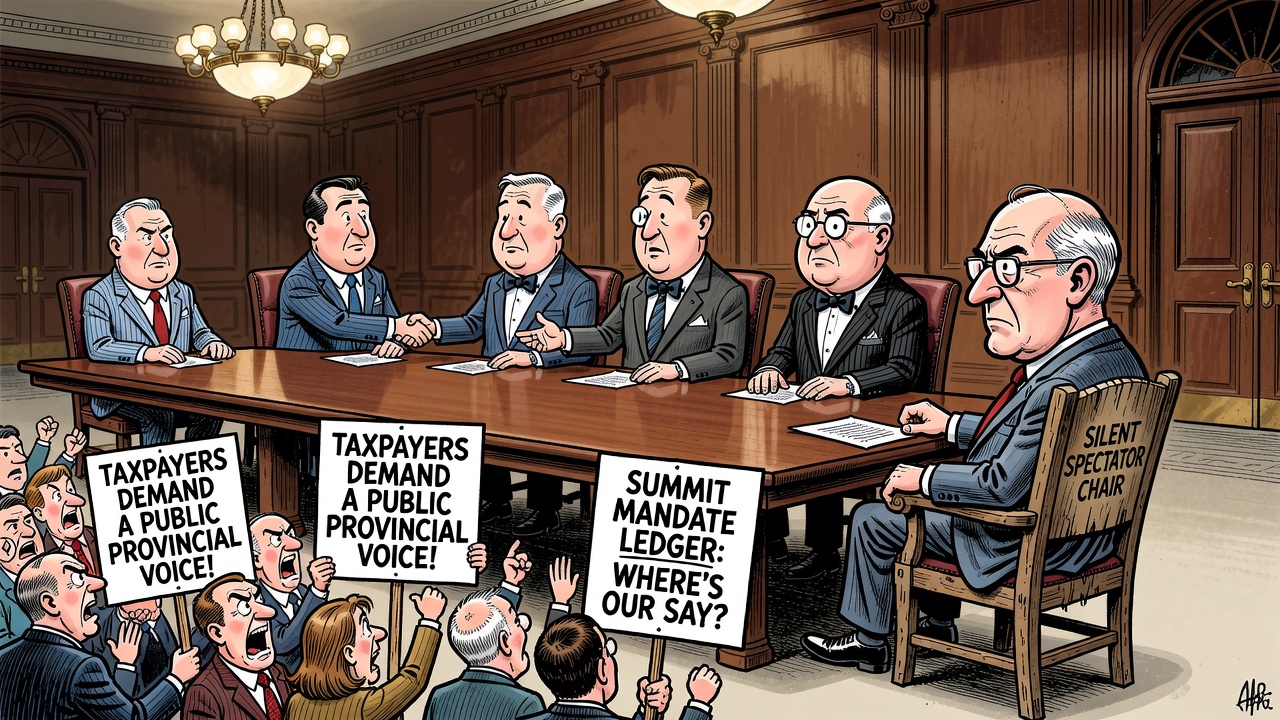
Canada’s federal government handles foreign affairs. That does not give Ottawa a blank cheque to choreograph away provincial interests when trade, taxes, technology, procurement and regional jobs are on the table.
Global News reported October 28 that Quebec Premier Paul St-Pierre Plamondon accused the federal government of trying to silence him at the Canada-EU summit in Brussels. The same summit produced a wider Ottawa-EU news cycle: Canada and the European Union announced a digital-trade agreement, Prime Minister Mark Carney discussed a possible replacement for Canada’s digital services tax, and officials pointed to cooperation on artificial intelligence, quantum technology, cybersecurity, rare earths and defence.
That is not a photo-op file. It is an economic-governance file. Provinces regulate, tax, permit, train workers, build infrastructure and absorb the local consequences when Ottawa signs broad international understandings. Quebec has direct interests in language, digital regulation, industrial policy, critical minerals, aerospace, energy, defence procurement and European market access. Alberta, Saskatchewan, Ontario, British Columbia and Atlantic Canada have their own interests too. A prime minister does not need every premier at every microphone. But if Ottawa is deciding who may speak, who may sit in the room, and whose priorities count, Canadians deserve the receipts.
The accountability standard is simple: publish the summit mandate, provincial consultation record, speaking-role criteria, attendee list, side-meeting list, draft-agreement summaries, and any federal-provincial notes that can be released without harming negotiations. If Ottawa rejected or limited Quebec’s requested role, say why. If the same rule would apply to every province, publish the rule. If the rule changes depending on politics, Canadians should know that too.
Carney’s government likes the language of grown-up management: discipline, seriousness, execution. Serious federalism requires more than asking premiers to applaud after Ottawa has already arranged the stage. It means showing that provincial voices were heard before federal ministers signed commitments in their name. It also means treating provincial objections as evidence to answer, not as inconvenient noise to manage on the margins of an international podium.
This is not an argument that Quebec, or any province, should run Canadian foreign policy. It is an argument that Ottawa should not hide behind diplomacy to avoid transparency. When agreements touch digital trade, cybersecurity, rare earths and defence, the provinces are not spectators. They are where the costs, compliance burdens and promised jobs land.
The conservative accountability position is not complicated: one country abroad, yes; one hidden Liberal script at home, no. If Ottawa wants Canadians to trust the Canada-EU summit, it should publish the provincial-voice ledger.
- Global News video: Quebec premier accuses federal government of trying to silence him at EU summit
- Global News / The Canadian Press: Canada, EU announce digital trade agreement as Carney says tax replacement possible
- Council of the European Union: Canada-EU summit, 27 October 2026
This article focuses on federalism, transparency and provincial consultation. It does not argue that any province should control Canadian foreign policy.