Carney’s National Security Strategy Still Needs a Delivery-and-Powers Ledger
The strategy is finally out — now publish the receipt ledger.
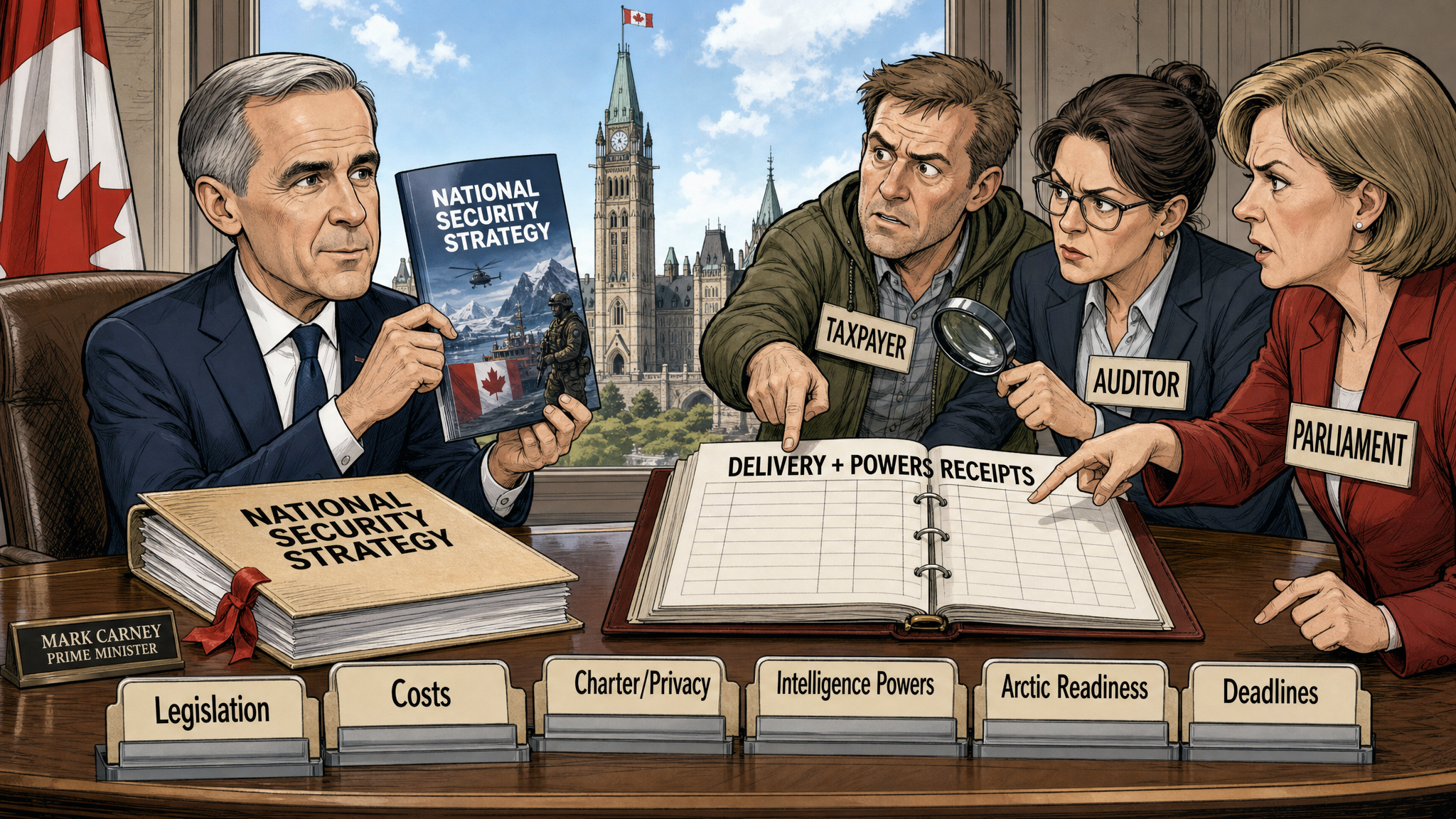
Ottawa finally has a new national security strategy. That is the good news. The accountability problem is that Prime Minister Mark Carney’s Plan for a Stronger Canada still reads like a power-and-delivery promise whose receipt book has not been published.
The Prime Minister’s Office says the October 29 plan is Canada’s first national security strategy in more than 20 years. It also says the old line between economic security and national security has disappeared. That is a major governing claim. Once a government says trade, industry, supply chains, defence, public safety and intelligence all belong inside one national-security frame, Parliament should ask for more than a glossy framework. It should demand the ledger.
The strategy rests on five foundations: economic security, foreign policy, defence policy, public safety and intelligence. On paper, those are serious files. Canada faces real threats: foreign interference, espionage, cyberattacks, organized crime, Arctic pressure, coercive trade, hostile economic activity and rapid technology change. Conservatives should not dismiss the need for national capacity. A sovereign country needs military readiness, secure infrastructure, intelligence tools, border control and resilient industry.
But seriousness cuts both ways. The Privy Council Office version repeatedly says the government “will produce a plan” under the major pillars. It will produce an economic-security plan. It will produce a foreign-policy plan. It will produce a defence plan. It will produce a public-safety plan. It will produce an intelligence plan. That is not a finished delivery schedule. It is a table of contents for future decisions.
Those future decisions may be enormous. The PMO says Ottawa will bring forward proposals within the first year to modernize national-security legislation. The strategy says intelligence authorities should be updated to reflect current threats and technologies while protecting Canadians’ rights. It also promises stronger enforcement tools against hostile foreign economic activity, expanded information-sharing with private-sector and research partners, strengthened CSIS, CSE and defence-intelligence capacity, and a broader approach to security clearances and sensitive information.
Those may be justified. They may also affect privacy, Charter rights, business confidentiality, procurement, parliamentary oversight and the relationship between federal agencies and provinces. Canadians should not have to wait for bills to appear before learning what powers are being considered, what problems they solve, what safeguards come with them and what independent review bodies will need to police them.
Canadian Press reporting carried by Eye on the Arctic noted that officials gave no specifics at the briefing on what the legislative modernization would entail. It also reported that the overarching framework will be followed by more detailed plans on foreign policy, defence, public safety, economic security and intelligence over the coming months. That confirms the central issue: the strategy has been announced before the full receipt package has been disclosed.
A conservative accountability standard is straightforward. If Ottawa wants broader national-security tools, it must publish a delivery-and-powers ledger: the legislation list, cost table, procurement exposure, Charter and privacy analysis, intelligence-authority changes, review-body resourcing, foreign-interference incident dashboard, Arctic readiness metrics and deadlines for every promised sub-plan.
National security is not a branding exercise. It is where governments claim exceptional authority because the risks are exceptional. That is exactly why the receipts must be exceptional too.
- Prime Minister of Canada: Prime Minister Carney launches The Plan for a Stronger Canada
- Privy Council Office: The Plan for a Stronger Canada — National Security for Canadians
- Eye on the Arctic / Canadian Press: Carney government’s national security strategy features focus on safeguarding economy
This article supports lawful, effective national-security tools against real threats. It argues that any expansion of powers must come with public cost, legal, rights, oversight and delivery receipts.