Carney’s Workforce Cuts Need Receipts, Not Slogans
If Ottawa is shrinking government, show the actual savings, service impacts and consultant offsets — department by department.
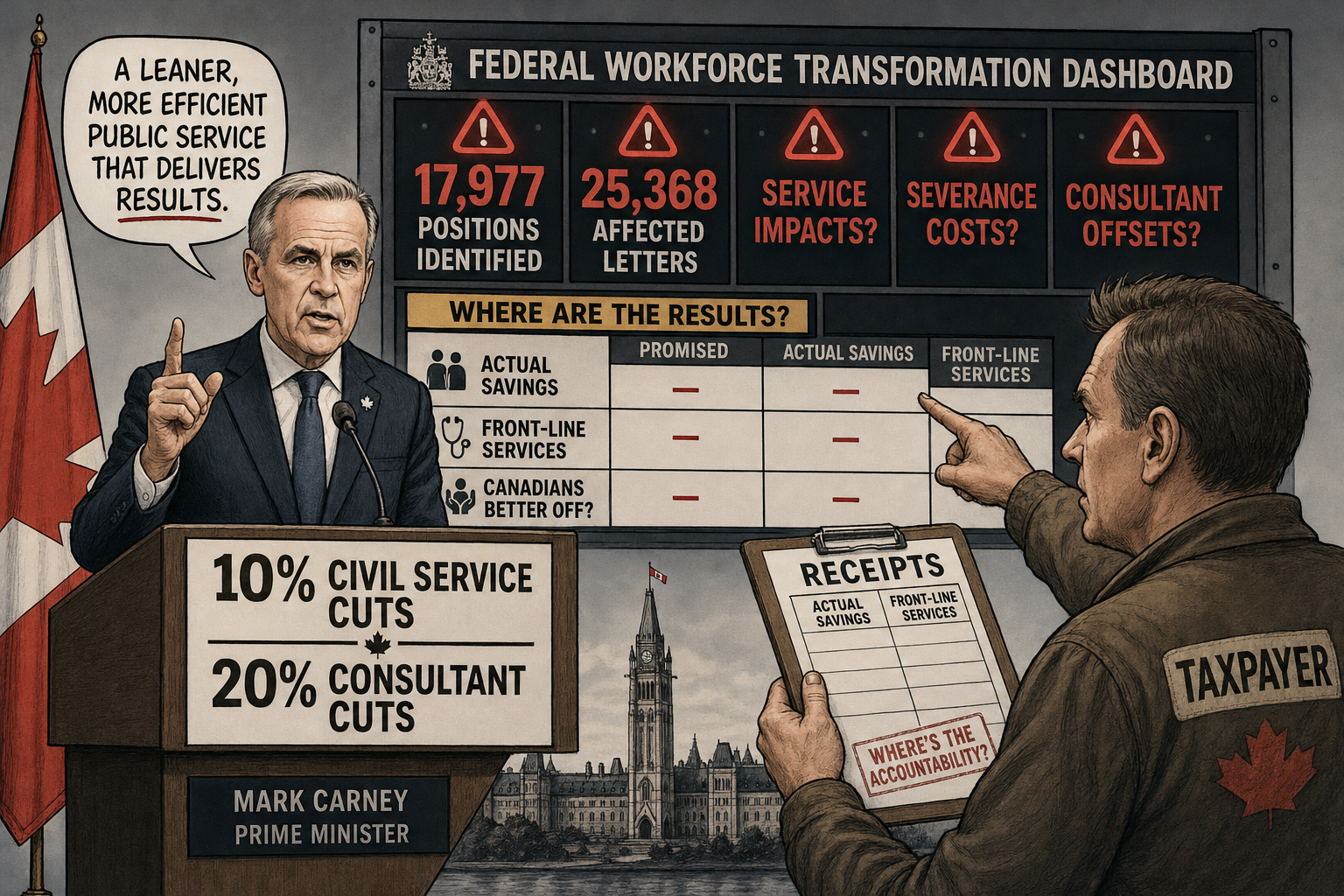
Prime Minister Mark Carney says Ottawa is cutting the bureaucracy. That sounds like fiscal discipline. It is not fiscal discipline until Canadians see the receipts.
Treasury Board says the government committed to returning the federal public service to about 330,000 employees after reaching close to 368,000 in 2023–24. Its public workforce-reduction page says Comprehensive Expenditure Review measures are expected to reduce the public service by about 16,000 full-time equivalents over three years, with another 1,000 executive positions targeted. As of October 14, departments and agencies had identified 17,977 non-executive positions and 832 executive positions to be eliminated.
Those numbers are big enough to matter. They are also incomplete. Treasury Board’s own table lists 25,368 affected-status letters for employees and 1,146 at-risk letters for executives, while warning that more people may be notified than ultimately leave. That means Canadians still do not know how many jobs are actually gone, how many have simply been reclassified, how many vacancies are being counted as savings, or how much severance and pension cost is being pushed into the same fiscal plan that is supposedly being repaired.
The accountability question sharpened in Question Period on October 28, when Carney claimed a “10% reduction in the civil service” and a “20% reduction in consultants.” If those cuts are real, the government should be able to publish the ledger: baseline head counts, reductions by department, executive versus non-executive reductions, consultant spending before and after, contract cancellations, service standards affected, severance costs, booked savings and the deficit line where those savings appear.
Conservatives should welcome a smaller, more focused federal government. But Canadians have seen too many Ottawa exercises where cuts hit front-line service while executive layers survive, consultants return through another door, and savings disappear into new spending announcements. A press-conference percentage is not a management plan. A workforce-adjustment webpage is not proof of fiscal repair.
The clean test is simple. If Ottawa is reducing staff, publish the department-by-department service-impact assessment. If executives are being cut, show the actual executive positions eliminated, not just letters sent. If consultants are down 20%, publish contract spending by vendor, department and category. If savings are booked, reconcile them to the deficit. And if Canadians will wait longer for passports, benefits, veterans’ files, immigration decisions or tax help, say so before the celebration tour begins.
Carney wants credit for restraint. Fine. Earn it with a public dashboard that distinguishes real savings from accounting theatre. Taxpayers are not asking for slogans. They are asking for the receipts.
- Government of Canada: Workforce reductions in the federal public service
- Treasury Board of Canada Secretariat: President of the Treasury Board appearance on Main Estimates 2026–27
- OpenParliament: House of Commons debate, October 28, 2026
- CityNews Vancouver / The Canadian Press: Federal departments, agencies to shed thousands of full-time equivalent positions
This article argues for public savings and service-impact disclosure. It does not allege wrongdoing by individual public servants.