Carney’s “Good Conversation” With Trump Needs a Public Concessions Ledger
A “good conversation” is not a trade win. If Ottawa is moving back toward a Canada-U.S. deal, Canadians deserve the concession ledger before ministers sell the outcome.
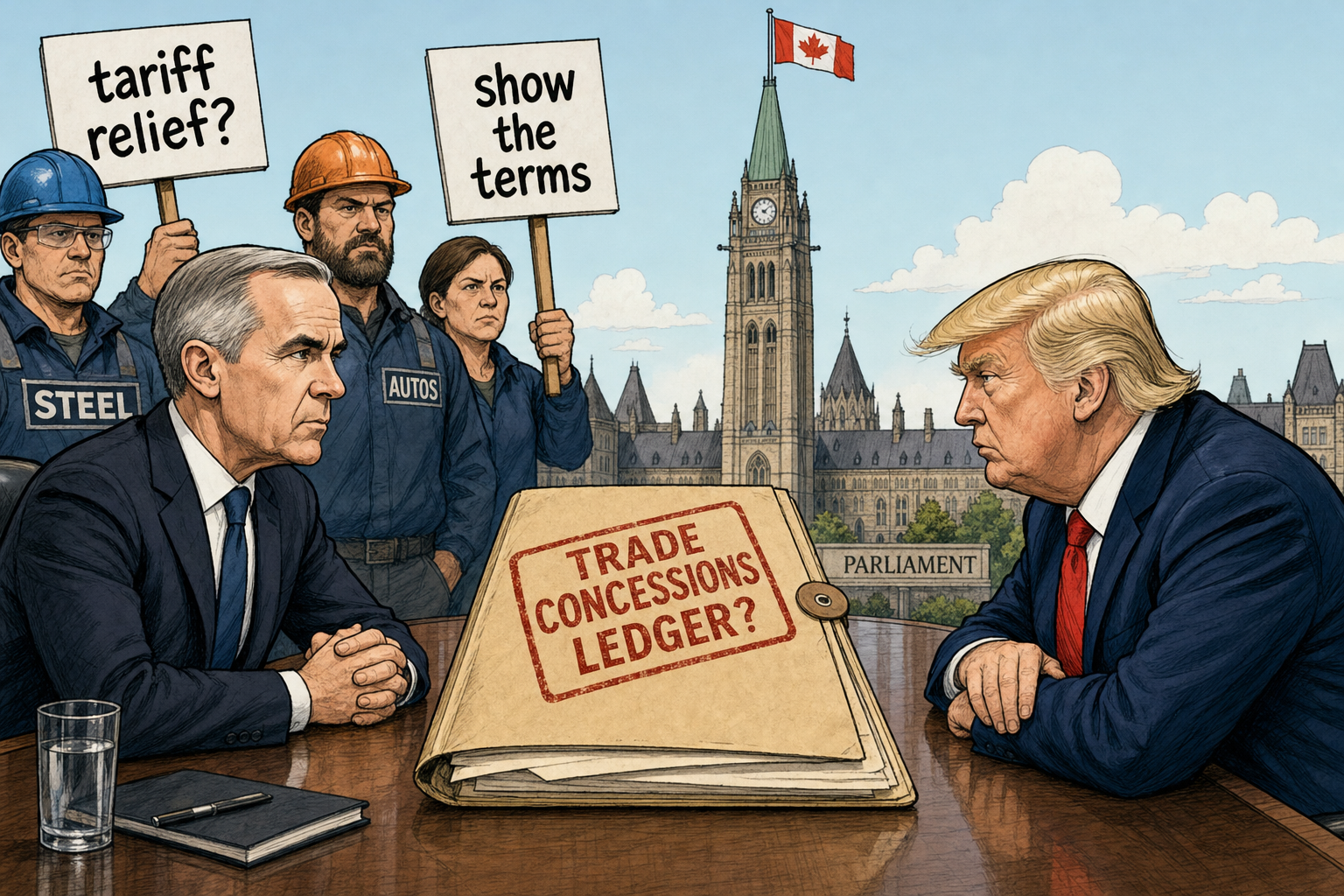
Prime Minister Mark Carney says the Canada-U.S. trade file is moving again. On Sunday, November 1, the Associated Press reported that Carney said he had a constructive conversation with President Donald Trump about a potential trade deal, and that negotiators from both countries would work in the coming weeks toward an agreement. Global News reported the same day that Carney described the call as a “good conversation” and said the teams would work toward a “mutually beneficial” deal.
That may be progress. It is not yet accountability. AP reported that the two sides have been discussing possible relief from U.S. tariffs on Canadian steel and automobiles, but that no details of a potential agreement have been announced. Those details are the whole story. Steelworkers, autoworkers, consumers and taxpayers should not be asked to applaud a headline before they know what Canada is giving up, what the United States is removing, and which sectors remain exposed.
The timing makes disclosure more important, not less. AP placed the renewed momentum days before the November 3 U.S. midterm elections and noted that the tariff fight is politically live in states such as Michigan and Maine. If Washington has domestic political reasons to show movement, Ottawa has an even stronger duty to prove that Canada is not trading away long-term leverage for short-term optics.
Carney’s own August 21 statement set the baseline. He said Canada had suspended trade negotiations after last-minute U.S. terms were unfair and uneconomic, and that the United States intended to impose a 50% tariff on roughly $28 billion of Canadian goods. He also said Canada would match those tariffs dollar for dollar and pointed to nearly $25 billion in support provided over the previous 18 months. That is a large public bill attached to a live negotiation. Canadians deserve more than reassurance.
The conservative accountability test is straightforward: publish a public concessions ledger. List the steel and auto tariff-relief terms, timelines, quota language, rules-of-origin changes, sector carve-outs, provincial commitments, Canadian counter-tariffs lifted or retained, worker-support costs, and any U.S. asks touching culture, language, agriculture, energy, procurement or future trade deals. Redact legitimate negotiating sensitivities where necessary, but do not hide the scoreboard.
Carney ran as the manager who could handle Trump. Fine. Competence should produce documents, not just adjectives. A good conversation can start a deal; it cannot substitute for the text. Before Ottawa declares victory, Parliament should see the terms, affected workers should see the protections, and taxpayers should see the cost.
- Associated Press: Canadian Prime Minister Carney reports progress in trade talks with Trump
- ABC News / Associated Press mirror: AP report on renewed Canada-U.S. trade talks
- Global News / The Canadian Press: Carney says teams will work toward a mutually beneficial trade deal
- Prime Minister of Canada: Statement on Canada-U.S. trade negotiations
- iVoteLiberal.com: Prior trade-deal text accountability coverage
This article argues for public accountability around any renewed trade agreement. It does not claim a final Canada-U.S. deal has been reached or that every tactical negotiating detail should be disclosed before talks conclude.