Carney’s PCO Transparency Failure Needs a Public Ledger
When the Prime Minister’s own central agency draws a record 63 access-to-information orders, Canadians should not have to guess where the bottlenecks are.
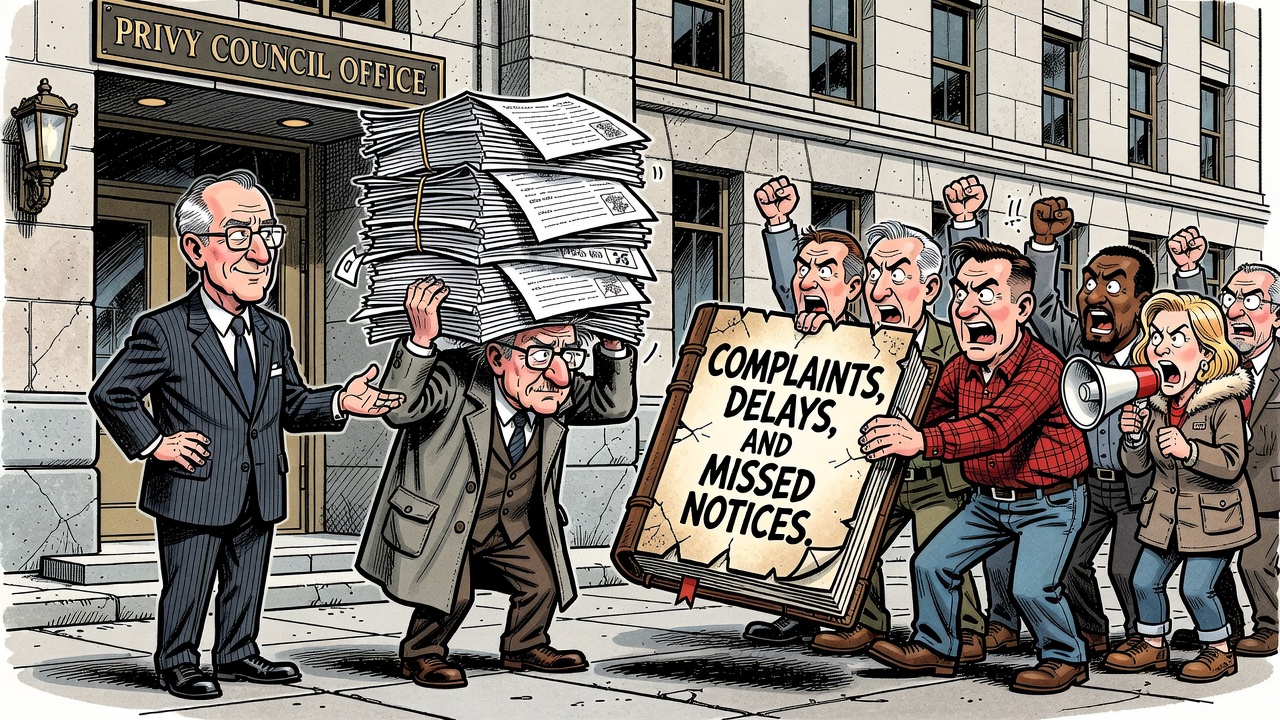
The Privy Council Office is not just another federal department. It is the Prime Minister’s central agency, the machinery that supports cabinet government, coordinates departments and sits closest to the most politically sensitive records in Ottawa. That is why the Information Commissioner’s latest annual report should worry anyone who still believes taxpayers have a right to see what their government is doing.
For 2025–26, the Commissioner reported that PCO had 217 complaints submitted, 225 complaints concluded and 63 orders issued. Those 63 orders were the most ever against PCO. The report also says well-founded outcomes accounted for 28% of PCO complaints concluded that year, compared with 8.6% across all institutions. In plain language: the Prime Minister’s own shop was not merely slow in a few edge cases. It was producing a far higher share of founded access problems than the government-wide average.
The compliance issue is even sharper because orders are supposed to trigger clear responses. The Commissioner reported that in 10 investigations concluded with orders, PCO did not give the required notice of whether it intended to implement the order. For ordinary Canadians, journalists, watchdog groups, businesses and opposition MPs, that is not a bureaucratic footnote. It is the difference between an enforceable transparency system and a records maze where the centre of government can run out the clock.
World Press Freedom Canada’s analysis put the numbers in public-facing terms: PCO’s 63 orders were a record for the department, rising from 25 in 2023–24 and 42 in 2024–25. The same piece noted that National Defence had more orders last year, but the Commissioner’s report described improvements there while continuing to flag PCO’s performance. That contrast matters. Bad performance can be fixed when leadership wants it fixed.
Conservatives do not need to pretend every cabinet record should be public or every exemption is illegitimate. National security, cabinet confidence, privacy and solicitor-client privilege exist for real reasons. But lawful exemptions are not a licence for chronic delay, internal approval bottlenecks or silence after a watchdog order. A government that campaigns on competent management should be able to manage records competently.
Carney should publish a PCO transparency ledger: monthly complaint counts, order counts, missed implementation notices, average completion times, consultation delays, delegation sign-offs, files under Federal Court review and corrective actions already taken. If PCO’s internal consultation and approval structure is slowing files down, say who can approve what, how long each step takes and what authority the access coordinator actually has.
The public does not own government only on election day. It owns the records, the process and the right to test official claims against documents. When the Prime Minister’s own department becomes a transparency problem, the fix starts with sunlight.
- Office of the Information Commissioner of Canada: 2025–2026 Annual Report
- World Press Freedom Canada: Transparency trouble at Carney’s Privy Council Office
- Office of the Information Commissioner of Canada: Letter to the Prime Minister, May 2025
This article argues for stronger access-to-information disclosure and public performance reporting. It does not allege unlawful conduct by individual public servants.